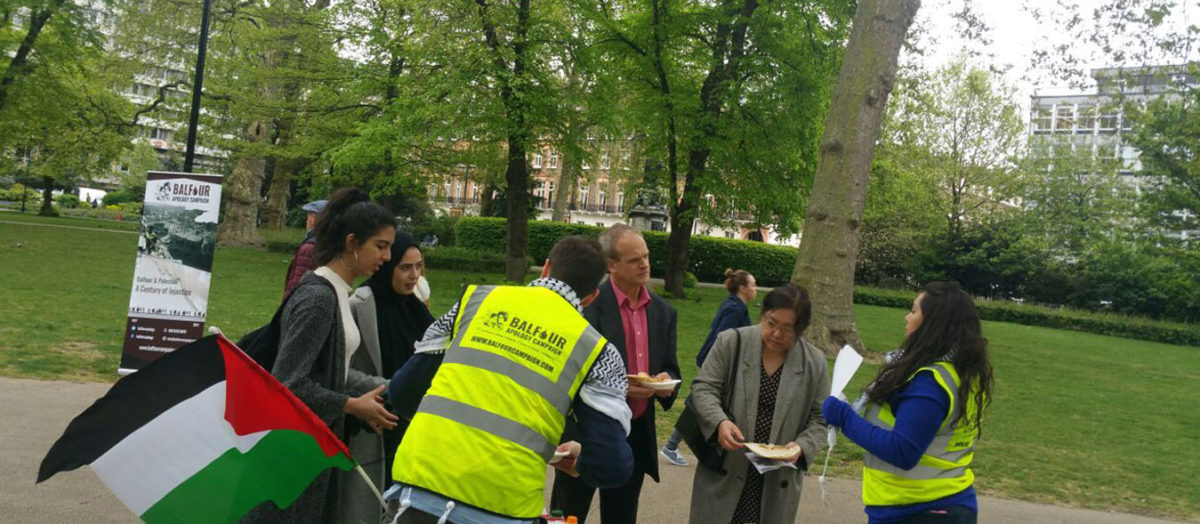
Balfour Apology Campaign Launched at House of Lords
London, 25th October
The Palestinian Return Centre hosted the launch of the Balfour Apology Campaign inside a packed out room in the House of Lords. The event was hosted and chaired by Baroness Jenny Tonge.
Balfour Apology Campaign is a UK based campaign launched by the Palestinian Return Centre (PRC) in 2013 to urge the British establishment to apologise for the 1917 Balfour Declaration. Britain’s legacy in Palestine marked an historical breach against the aspirations of the people of Palestine and shattered its hopes for freedom and self determination.
Baroness Jenny Tonge introduced introduce the evening stating “Tonight is the beginning of the apology” as she provided some background on the origins of the campaign and its significance for Palestinians.
First speaker of the evening was Majed Al-Zeer, President of the Palestinian Return Centre. Mr Al-Zeer. In regards to the launch of the Balfour Apology Campaign, he stated that “We want official recognition of Palestinian suffering”. Mr Al-Zeer continued “We are committed to fight for the self-determination of Palestinians”.
The next speaker, Karl Sabbagh, British Palestinian Historian and Writer, discussed the three conditions that need to apply in order to seek an apology – harm caused, responsibility of the apologiser, and whether the original event was avoidable.
Last speaker of the evening was Betty Hunter, Honorary President of the Palestine Solidarity Campaign discussed the importance to unite works towards changing British policy on Palestine. For Hunter it is fundamental to do so because “The Palestinian catastrophe is still ongoing” and the “International community must stand with Palestinian refugees”.

Session in Human Rights Council on Balfour Declaration Centenary
London, Geneva 26th September 2017
The Palestinian Return Center (PRC) organized a panel discussion on the sidelines of the 36th Session of the UN Human Rights Council in Geneva.
The session focused on the centennial of Balfour Declaration and Britain’s responsibility of it, where participants urged Britain to apologize for its declaration, which left millions of Palestinians homeless and created endless calamities.
Professor Salman Abu Sitta, member of PRC’s Advisory Board, presented a historical presentation since the Balfour Declaration until 1948, in which he discussed Britain’s role in consolidating the establishment of the Israeli occupation state and committing massacres against the Palestinian people.
Abu Sitta requested an urgent apology from Britain and a financial compensation to the Palestinian people, for the damage and destruction that took place over the course of 100 years.
During the discussion, president of the Palestinian Prisoners’ Club, Qadoura Fares, criticized Britain’s refusal to apologize. He stressed that the Palestinian public inside the country and in the diaspora, fully agreed on the need for Britain to take full responsibility.
Majed Al-Zeer, Chairman of the Palestinian Return Center, referred to the work of civil society institutions and human rights defenders and their role to put pressure on the British government, which is still denying its colonial history.
The meeting was co-chaired by human rights expert Gulnoz Saydaminova, Senior Human Rights Researcher at Geneva International Centre for Justice (GICJ), and Badie Dweik, Founder and Coordinator of Hebron Human Rights Defenders (HRD), who gave a detailed account of human rights violations in the West Bank, especially Hebron, committed by the Israeli occupation and its settlers.

“Balfour Road 100” film shows in The Rainbow Art House Theatre in Jordan
Amman, 22nd September 2017
“Raaji” Center in Jordan, in collaboration with the Palestinian Return Center, held the first screening of the film “100 Balfour Road” in the Hashemite Kingdom of Jordan on Thursday, September 21st, 2017 at the Rainbow Cinema in the capital Amman.
This came concurrently with the centennial of the Balfour Declaration, which is happening these days, in the presence of a large and diverse crowd of more than 300 people.
The screening was followed by a discussion session with the speakers: Dr. Anis Kassem, PhD in law from George Washington University USA and a member of the Palestinian defense lawyers team before the International Court of Justice in the Israeli Wall case, Dr. Ali Muhafazah, Honorary Professor of History at the University of Jordan and the former President of Mutah and Yarmouk Universities. And the Palestinian filmmaker Rawan Al-Daman as a moderator.
Dr. Ali Muhafazah discussed the Balfour Declaration from a historical perspective. He also spoke about the origin of the idea of immigration to Palestine as a religious cover for colonial purposes.
Dr. Anis Kassem discussed the legal perspective of Balfour’s statement and its impact on drawing the course of the Palestinian issue until now, in addition to how the Zionist movement was able to convert the text of the Balfour letter into a colonial state.
Rawan Al-Daman highlighted the importance of the digital media role in gaining international support and backing for the Palestinian cause.
This event comes as part of activities taking place around the world where the 100 Balfour Road short film is being shown. The film, produced by the Palestinian Return Centre and Balfour apology campaign, aims to raise awareness of the tragic consequences of the promise on the Palestinian people and the extent of British responsibility.

Arthur Balfour Apologizes to Palestinian Child
London – 10th July 2017
A short film screened by the Palestinian Return Center (PRC) on Saturday evening got a standing ovation at its London premiere.
The film, 100 Balfour Road, put on show for the first time at Queen Elizabeth II Centre in London, exerted a pull on dozens of activists and pro-Palestine figures.
The film, displayed as part of the Palestine Expo event, which bills itself as Europe’s largest Palestinian heritage event, also dovetails the Balfour Apology Campaign launched by PRC to urge the British Government to apologize for the notorious Balfour pledge.
The film puts on view the tragic fallouts of the Balfour Declaration, in which the British Foreign Secretary Arthur Balfour signaled the go-ahead for the establishment of a Jewish State in Palestine.
The film spotlights the story of a British family who are driven out of their home by the British government and forced to live in a cramped shack in the backyard. Another family—the Smiths—take possession of the house and put down roots in the building, leaving the real houseowners—the Jonees—with neither food nor medicines. Heavily-armed soldiers escort the settlers at the same time as they tighten the noose around the neck of the Johnees and deprive them of their basic rights.
The show was wrapped up by a seminar during which PRC delegates and the film producers briefed the audience on the challenges faced all the way through the pre-screening phases.
The leading actor Tim Bartholomew, who played the character of Balfour, expressed his heartfelt pride of the positive responses garnered by the premiere.
He said though he did not know much about Balfour Declaration previously, he believed, deep inside, that the tragedy of the Palestinians did not occur out of the blue.
“I am now more aware than ever of the truth. It is high time we reacted to the tragedy. On behalf of Arthur Balfour, I would like to apologize to the child Henry and to the Palestinians for the harm wrought by the pledge for over 100 years,” said the protagonist.
Responding to a question by journalist Rawan AlDhamen on the cast, the Palestinian-British film director, Anas AlKarmi, said British actors were selected to play the leading roles in order to strike a chord with the targeted audience and make the British people identify with the victims.
PRC’s Public Relations and Communications chief, Sameh Habeeb, sounded the alarm over Britain’s historical responsibility over the upshots of the Balfour pledge, which forced the Palestinians out of their homes and robbed them of their right of return to their motherland.
“The right of return is inalienable and can never be subject to a statute of limitations,” said Habeeb.
The film falls in with the Balfour Apology Campaign launched by PRC to push the UK government to extend an official apology over the pledge and backtrack on its intent to celebrate the Balfour Declaration centenary.
The scenario was composed by prominent English screenwriter and film director Richard Beer, best known for his “One Second a Day” video clip, which relates the story of a young girl whose life gets upside down in the raging Syrian warfare. The video was seen by over 57 million people on YouTube.
Balfour Road film is the by-product of a team work carried out by: Ammar AlZeer (audiographer), Abdul Mu’ti AlTirawi (assistant director), Anas al-Karmi (director), Imagine (executive producer). The film was prepared by Ali Faraj and produced by PRC.
Giving Away Other People’s Land.. The Making of the Balfour Declaration
On the centenary of the Balfour Declaration the Palestinian Return Centre (PRC) launches its latest publication titled “Giving Away Other People’s Land, The Making of the Balfour Declaration”.
With the 1917 Balfour Declaration, Palestine became the victim of European colonialism, as Britain promised to establish a Jewish homeland in Palestine where the indigenous Palestinians amounted to over ninety percent of the total population.
This report provides an in-depth analysis of the motivations and dynamics that culminated in the creation of the Balfour Declaration.
The research is based primarily on archival documents from the National Archives in Kew Gardens, London. The reports begins with illustrating the objections to the Zionist project to settle in Palestine, strongly advocated by anti-Zionist British Jews.
Contrary to the mainstream view that Britain had benevolent motivations in drafting the Declaration evidence in the archives proves that British government ministers used political Zionism to advance their own imperial ambitions.
The report also explores the accusation that the British ruling elite were anti-Semitic and thus driven by an age-long ambition to expel their Jewish communities. Lastly, this study argues that both the British government and the Zionist movement used Orientalist ideology to justify the dispossession of Palestinians from their lands.
This publication is of relevance to academics, students, policy makers and activists interested in the history and politics of British imperialism, settler colonialism, Zionism, Israel and the question of Palestine.
Researcher: Hannah Bowler
Editors: Sameh Habeeb and Pietro Stefanini
- Paperback: 52 pages
- Publisher: The Palestinian Return Centre
- Language: English
- Date: 2017
- ISBN: 978-1-901924-07-7
- Price: £ 10.00 (+p&p outside UK)
- Dimensions: 18 x 24 cm
PRC Protests to Sadiq Khan Against TfL’s Ban of a Palestinian Ad Ahead of Balfour Centenary
London 18 October 2017
The Palestinian Return Centre (PRC) has written a letter to the Mayor of London, Sadiq Khan to protest against Transport For London’s decision to ban advertisements displaying Palestinian objection to the Balfour Declaration.
PRC is extremely disappointed that TFL has refused to run the Palestinian Mission UK’s advocacy campaign that aims to raise awareness about the effects of the Balfour Declaration on the Palestinian people. It is a timely campaign that seeks to inform the British public of the gravity of the Balfour Declaration, which was instrumental to the forced expulsion of the Palestinian people and to their suffering ever since it was declared.
The advertising campaign was allegedly rejected under clause 2.3 (h) of the Advertising Policy, referring to “images or messages which relate to matters of public controversy or sensitivity”. However, we would like to emphasize the remainder of the same clause which states “advertisements which are calculated to promote the right to life, liberty and security of the person, and advertisements which reasonably promote causes which are not party political, will however not normally be disapproved on this ground”. The campaign is wholly factual in content and voices the abuse of rights of the Palestinian people with the purpose of calling attention to their liberty, or lack thereof.
Additionally, we seriously question the rejection of the advertising campaign under this clause, given the TFL’s support of a 12-month BAE systems campaign at Westminster tube station. BAE systems have been known to supply Israel with ‘Head-Up Displays’ (HUD) for F16 fighter aircrafts, which have been used by the Israeli army to destroy Lebanese and Palestinian villages and towns into rubble. BAE system’s products also include radar systems, handcuffs and shackles used in Guantanamo Bay and Saudi Arabia. TFL and Greater London Authority’s Sponsorship explicitly states under clause 5.5 (f) that “The Authority will not enter into agreements for sponsorship from organisations deriving income from pornography, or immoral activities.”
Britain has a legal and moral responsibility to take tangible restorative action and give the Palestinians basic rights and self-determination, but this ban only acts to censor the Palestinian narrative. We condemn the decision to reject this advertising campaign, and urge you to reverse this ban in the interest of promoting the right to life, liberty, and security, as is set out in TFL’s Public Sector Equality Duty 5.5 (f).
PRC briefs Labour MP Jared O’Mara
London 9 October 2017
The Palestinian Return Centre (PRC) briefed British Labour Party politician Jared O’Mara, Member of Parliament for the constituency of Sheffield Hallam since 2017.
The PRC gave a presentation to Mr. O’Mara detailing the situation of Palestinian refugees across the Middle East and in Palestine-Israel. PRC stressed the importance of the Palestinian right of return.
Mr. O’Mara talked about the support for Palestinian rights from members of his constituency and the need to address the situation in Gaza especially since the ‘electricity crisis’ further worsened the already desperate conditions.
PRC also discussed its own activities within Parliament, the United Nations and the Balfour Apology Campaign. The way the government will ‘mark’ or ‘celebrate’ the centenary of the Balfour Declaration was addressed with great concern by both Mr O’Mara and PRC.
Mr O’Mara said he looks forward to working with other members of parliament to end the oppression of the Palestinian people.
PRC opens the door for those who wish to hold a screening event for (100 Balfour Road) short film
As the centennial of the infamous Balfour Declaration approaches, the Palestinian Return Centre (PRC) opens the door for those wishing to hold a screening event for (100 Balfour Road) short film.
The film aims to raise awareness of the disastrous effects of the Balfour Declaration on the Palestinian people by dramatizing it as a traditional British family story, suitable for family viewing and free of violence.
The 12 Mins film, produced by the Palestinian Return Centre and Balfour Apology Campaign, speaks English, but subtitles provided in 16 world languages: Arabic, Spanish, French, German, Danish, Dutch, Swedish, Polish, Italian, Turkish, Hindi, Urdu, Farsi, Chinese, Russian, Indonesian.
Session in Human Rights Council on Balfour Declaration Centenary
London, Geneva 26 September 2017
The Palestinian Return Center (PRC) organized a panel discussion on the sidelines of the 36th Session of the UN Human Rights Council in Geneva.
The session focused on the centennial of Balfour Declaration and Britain’s responsibility of it, where participants urged Britain to apologize for its declaration, which left millions of Palestinians homeless and created endless calamities.
Professor Salman Abu Sitta, member of PRC’s Advisory Board, presented a historical presentation since the Balfour Declaration until 1948, in which he discussed Britain’s role in consolidating the establishment of the Israeli occupation state and committing massacres against the Palestinian people.
Abu Sitta requested an urgent apology from Britain and a financial compensation to the Palestinian people, for the damage and destruction that took place over the course of 100 years.
During the discussion, president of the Palestinian Prisoners’ Club, Qadoura Fares, criticized Britain’s refusal to apologize. He stressed that the Palestinian public inside the country and in the diaspora, fully agreed on the need for Britain to take full responsibility.
Majed Al-Zeer, Chairman of the Palestinian Return Center, referred to the work of civil society institutions and human rights defenders and their role to put pressure on the British government, which is still denying its colonial history.
The meeting was co-chaired by human rights expert Gulnoz Saydaminova, Senior Human Rights Researcher at Geneva International Centre for Justice (GICJ), and Badie Dweik, Founder and Coordinator of Hebron Human Rights Defenders (HRD), who gave a detailed account of human rights violations in the West Bank, especially Hebron, committed by the Israeli occupation and its settlers.