Baroness Tonge Hosts Debate on UK Gov’t’s Intent to Celebrate Balfour Declaration
London – 29 March 2017
A debate was organized by the Palestinian Return Centre (PRC) on Tuesday evening at the British House of Lords under the patronage of Baroness Jenny Tonge to discuss underway arrangements by the UK government to mark the notorious Balfour Declaration.
The event, held under the slogan “No for Celebration . . . Yes for Apology”, was chaired by Lord Norman Warner. A number of academics were in attendance. A minute of silence was held at the onset of the event in memory of the victims of the Westminster terror attack and of the departed pro-Palestine MP Gerald Kaufman.
Keynote speaker Professor Salman Abu Sitta held the UK historically responsible for the fallouts of the Balfour Declaration, which resulted in the influx of thousands of Jewish immigrants and Zionist gangs to Palestine.
Speaking on behalf of Friends of Sabeel UK, Rev’d Mark Battison highlighted the key role played by the Church of England in ongoing campaigns promoting Palestinians’ infringed rights.
Palestinian writer, Dr. Ghada Karmi, stressed Palestinians’ inalienable right of return to their motherland and the tragic upshots of the Balfour pledge on the refugees’ cause. She slammed the international community for their apathy as regards the status quo. Irish author and journalist David Cronin briefed the audience on the finding of his book Balfour’s Shadow: British Support for Zionism and Israel, slated to be published in the near future. The book covers the repercussions of the Balfour pledge on the entire region and the wars sparked by the declaration.
PRC’s Chairman @mzeer2 Majed AlZeer concluded the seminar with an extensive note on PRC’s efforts to urge the British government to apologize for the Balfour Declaration and to pin down the ad hominem campaigns waged by the Israeli lobby against the center over the past few months.
AlZeir further underlined the findings of a report by the Parliamentary Inquiry Committee acquitting Baroness Tonge of anti-Semitism allegations.
Parliamentary Investigation slams false accusation against Jenny Tonge and PRC
London – 20th March 2017
The Parliamentary Committee for Privileges and Conduct dismissed allegations of anti-Semitism against Baroness Jenny Tonge for hosting the launch of the Balfour Apology Campaign on October 25th 2016, in the House of Lords.
Following media reports from The Times and the Jewish Chronicle on the meeting under the headline “Jews blamed for Holocaust at ‘shameful’ House of Lords event” and after receiving complaints from Mark Regev, Israeli Ambassador to the UK, and members of the House of Lords, an official investigation was initiated by the Committee for Privileges and Conduct.
It was alleged that Jenny Tonge has breached the Code of Conduct, which requires members to act on their personal honor but The Committee has decreed a resounding result which states:
It is clear from the transcript that the event as billed—to launch the Palestinian Return Centre’s Balfour Apology Campaign—was what took place, and that the event was not intended to promote antisemitism. I find that there was no takeover of the event by people promoting antisemitism, and that therefore Baroness Tonge was not obliged to deal with any such takeover.
The report added:
For the above reasons I find that Baroness Tonge did not breach paragraph 8(b) of the Code of Conduct in her hosting and chairing of the meeting on the parliamentary estate on 25 October 2016.
The Palestinian Return Centre (PRC) welcomes the findings of the investigations which sheds light on the truth regarding the launch of the Balfour Apology Campaign and the appalling targeted campaign to silence pro-Palestinian activists and smear them as anti-Semites.
The false accusations of anti-Semitism from the media and the Israeli Embassy were categorically refused by the Committee for Privileges and Conduct, and the investigation refuted as well the claim that the comments made by the member of the Naturei Karta amounted to ‘Holocaust denial’. And the claim from most mainstream media that the audience applauded after an audience member made an anti-Semitic comment was also proved to be incorrect.
Lastly, comments made by speaker Betty Hunter that were alleged to be anti-Semitic were also found to not even meet the new contentious IHRA definition of anti-Semitism. The investigation found that criticizing Israel as a “racist and colonialist state” clearly does not breach the new definition.
Read the full text of the Parliamentary investigation: https://www.publications.parliament.uk/pa/ld201617/ldselect/ldprivi/142/14205.htm#_idTextAnchor007
Connecting Palestinian Archives
Researching the national history of a stateless people always necessitates collecting disparate documents from a wide range of archives. For the past two years I have been researching my PhD thesis on the history of the Palestinian refugee camps and the organisation responsible for them, UNRWA (the UN Relief and Works Agency for Palestine refugees).
In the absence of a Palestinian national archive, the relevant records are dispersed across the world, and it is left to the researcher to pull them together and examine the collective evidence. The relevant archives can be found not only in the Middle Eastern countries where the camps are located, but also in the Western states that have played such a key role in regional politics, particularly the US and UK.
The National Archives was the first collection I looked at for this project. My decision to start here was taken largely for logistical reasons; commitments kept me in London during the first few months of my PhD. I had expected to find a small amount of useful supplementary evidence in Kew, rather than anything crucial or revelatory. Initially, my fairly mundane days in the archive bore this out. I found useful but dry UNRWA records from the Agency’s early days, and letters between British and American diplomats about the political impact of the refugee crisis. The documents were informative, important, and expected.
Yet among them were some unexpected gems. I was particularly struck by a letter to the Prime Minister from Ali Ahmed El-Abed, a Palestinian pleading for the UK to enforce the refugees’ right to return to Palestine. He had written:
We were under the protection of the British crown for thirty years, but the result is that we are scattered away, far from our homes, our country and our people… Our situation goes from bad to worse so that Death is nearer to us than Life. We still consider ourselves under British protection and carry passports with the British crown on. Use your powers to send us back to our country.
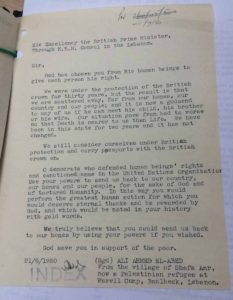
Ali Ahmed El-Abed’s letter to the British Prime Minister in 1950 (catalogue reference: FO 1018/73)
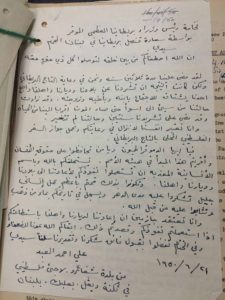
The original handwritten letter from Wavel Refugee Camp in Lebanon (catalogue reference: FO 1018/73)
I had not expected to find much in the way of refugee voices in the state archives of the former Mandate power, and letters such as this added unanticipated personal notes to the dry diplomacy.
On completing my research in Kew, I judged that as expected, I had found some useful supplementary documents with relatively low-key significance. What I did not realise at that stage was the true importance of many of the documents, which only became apparent when contextualised with evidence from archives elsewhere.
Upon visiting the latter, I discovered that letters like that I found at Kew were not outliers, but in fact typical of a wider trend for Palestinian refugees to protest their plight in writing. Across archives in Jordan and Lebanon, I found similar letters to national and international authorities, alongside organised petitions. They were crucial evidence for what became a central part of my thesis; namely, the fact that the Palestinian refugees were not ignorant passive recipients of international aid, but active agents who were fully aware of their rights and very quickly organised themselves to demand them.
My research in the Middle East threw up even more surprises about the diplomatic documents to which I had previously given little thought. During months of research at numerous archives in Jordan and Lebanon, I was unable to track down records about the beginning of UNRWA’s schooling programme for Palestinian refugee children. The UNRWA archive in Amman contained detailed information about later decades, as did the Institute for Palestine Studies in Beirut, but the early days were drawing a blank. Returning to my notes from Kew, I was astonished and delighted to find that a key document was already in my hands. Amidst the FCO’s records about the Palestinian refugee situation was an early Information Sheet from UNRWA detailing precisely when and how the first camp schools were started.
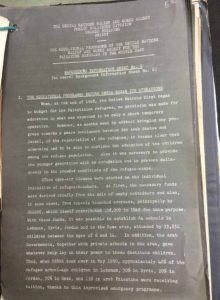
Details about the first schools for Palestinian refugees in exile eluded me in numerous international archives, but are found here. Background Information Sheet No. 9 from the UNRWA Public Relations Division, 5 June 1952 (catalogue reference: ED 157/366)
This document provided a crucial complement to later records detailing UNRWA’s interactions with the Palestinian refugees about the schooling programme. Using the evidence from records like that in Figure 3, I was able to establish that the refugees had pushed from the beginning for a full education programme. Yet out of context the document’s significance was greatly diminished. Its increased value when combined with others exemplifies the importance of connecting collections, and the need to reconsider individual documents in the context of others in order to arrive at more nuanced and comprehensive conclusions.
[Source]: Connecting Collections: http://blog.nationalarchives.gov.uk/blog/stateless-history-connecting-palestinian-archives/#more-32227

Balfour Apology Campaign urges Royal Family to reject visit invitation to Israel
London, 10 March 2017
Balfour Apology Campaign (BAC) is concerned about the possible British Royal Family visit to Israel. Reports in British media have suggested an unprecedented Royal Family visit to Israel following the visit of Foreign Secretary Boris Johnson meeting with Israeli PM and Israeli President.
According to the Independent “The first state visit by a British Royal to Israel will go ahead this year, Whitehall sources have suggested.”
While the uncertain visit has not been confirmed by the Royal Family our campaign urges the royal Family to reject this possible visit.
The royal family visit to Israel is seen by the Campaign and Palestinians under Occupation and in the Diaspora as “unhelpful”. Such a visit will only encourage Israel to continue its human rights violations against Palestinians and provide free publicity to cover Israel’s ongoing settler colonialism, occupation and apartheid policies.
The Campaign will communicate with the royal family asking for clarification on this matter.
Balfour Apology Campaign urges Royal Family to reject visit invitation to Israel
London, 10 March 2017
Balfour Apology Campaign (BAC) is concerned about the possible British Royal Family visit to Israel. Reports in British media have suggested an unprecedented Royal Family visit to Israel following the visit of Foreign Secretary Boris Johnson meeting with Israeli PM and Israeli President.
According to the Independent “The first state visit by a British Royal to Israel will go ahead this year, Whitehall sources have suggested.”
While the uncertain visit has not been confirmed by the Royal Family our campaign urges the royal Family to reject this possible visit.
The royal family visit to Israel is seen by the Campaign and Palestinians under Occupation and in the Diaspora as “unhelpful”. Such a visit will only encourage Israel to continue its human rights violations against Palestinians and provide free publicity to cover Israel’s ongoing settler colonialism, occupation and apartheid policies.
The Campaign will communicate with the royal family asking for clarification on this matter.
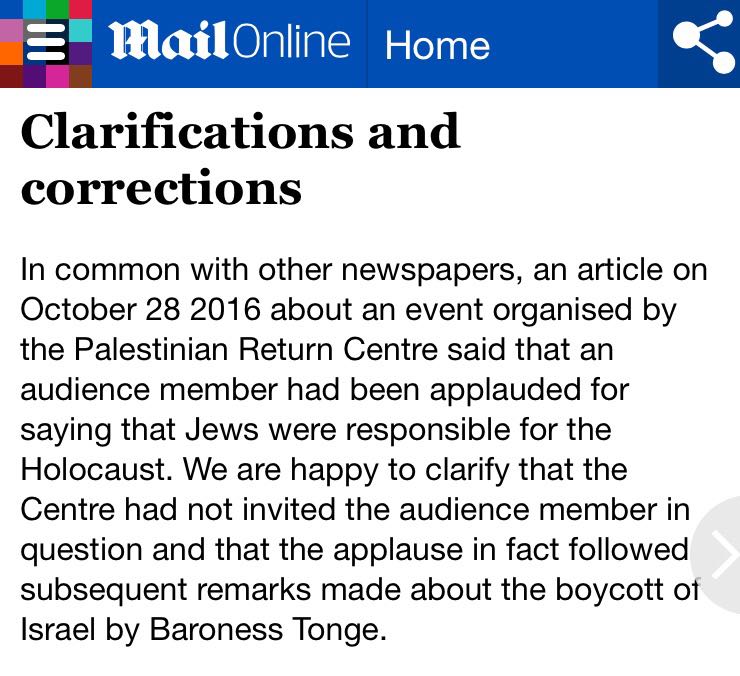
Daily Mail Backtracks on Inaccurate Coverage of PRC House of Peers Event
The English-speaking Daily Mail newspaper backtracked on inaccurate media coverage of a PRC seminar held at the House of Lords in October 2016, and which was chaired by Baroness Jenny Tonge, to announce the launch of the Balfour Apology Campaign (BAC).
The move comes following continuous pressure and follow-up by PRC. The paper faced press watchdog probes and calls for further amplifications by the Independent Press Standards Organization (IPSO).
PRC had formally protested against the paper’s counterfeit reporting to the Independent Press Standards Organization (IPSO) and pushed for an immediate apology by Daily Mail.
In an apology published by Daily Mail on March 7 under the heading “Clarifications and Corrections”, the paper backtracked on comments that figure in an article published on October 28, 2016 accusing the audience of applauding a speaker “for saying that Jews were responsible for the Holocaust.”
Daily Mail acknowledged that the speaker in question had not been invited by PRC and that the round of applause “in fact followed subsequent remarks made about the boycott of Israel by Baroness Tonge.”

PRC protests to PM the possibility of Balfour Declaration Celebrations
London, 7 March 2017
The letter below stated , ” After 100 years of this Declaration, Palestinians remain displaced in the refugee camps and denied their right to return to their homeland. They are living under a fifty-year military occupation depriving them of basic human rights and suffer daily humiliation at Israeli checkpoints. Palestinians are made homeless due to the increasing settlement expansion, which Parliament has recently reaffirmed their illegality and an obstable to peace.”
Below the letter sent to the PM
7 March 2017
Dear Rt Hon Theresa May MP,
The Prime Minister,
Subject: Celebrating the “Balfour Declaration Centenary”
The Palestinian Return Centre (PRC) is very concerned about the possibility of the British Government or any of its institutions, bodies or senior figures; celebrating or marking the centenary of the Balfour Declaration. We have followed up closely the calls of the pro Israeli groups to celebrate or mark this infamous centenary.
As you may know, for millions of Palestinians the Balfour Declaration is not a source of pride but rather, displacement and agony. Britain’s Middle East Minister, Tobias Ellwood, said in a Parliamentary debate in November 2016 that Government will not “celebrate” the Centenary and will be taking “a measured approach”. Meanwhile, recent media reports suggest that your Excellency has “invited” Israeli Prime Minister to London to celebrate the occasion. The PRC is certain that you are fully aware that the Balfour Declaration has led us to this current moment of continued conflict and instability.
After 100 years of this Declaration, Palestinians remain displaced in the refugee camps and denied their right to return to their homeland. They are living under a fifty-year military occupation depriving them of basic human rights and suffer daily humiliation at Israeli checkpoints. Palestinians are made homeless due to the increasing settlement expansion, which Parliament has recently reaffirmed their illegality and an obstable to peace.
Moreover, Israel has repeatedly violated International laws and UN resolutions as well as committing war crimes in Gaza Strip in the last three military offensives in 2009, 2012 and 2014. The centre firmly believes that celebrating or marking the Balfour Declaration would lead to further damage to Britain’s image not only in Palestine but across the region.
As you may aware, the British Mandate and involvement in the Arab world early in 20th Century is negatively perceived as a foreign “colonial” and “imperialist” project. Therefore, we kindly request that Number 10 issue a statement to confirm its position.
We call on HMG to openly apologise and recognise the suffering caused to Palestinians following the Balfour Declaration during the Mandate years and how it contributed to their current plight. This moral and ethical step would greatly contribute to advancing the cause of justice and achieving peace in the region.
The Palestinian Return Centre (PRC) is a non-governmental organization, with UN ECOSOC special consultative status, registered in London that is dedicated to finding a solution for Palestinian refugees in accordance with international and humanitarian law through organising conferences, events, delegations and published materials, working with Palestinians alongside UN and government officials. We are also a member NGO on Committee on the Exercise of the Inalienable Rights of the Palestinian People since 2003.
Best
The Palestinian Return Centre (PRC)

Daily Express correct its Inaccurate Coverage of PRC House of Commons event
The Daily Express Newspaper made clarifications over inaccurate media coverage of the launch of Balfour Apology Campaign hosted in the House of Lords last October by Baroness Jenny Tonge.
The paper published an amplification on the printed and electronic versions of the newspaper
In an article published by Daily Express on Friday, October 28, the journalist claimed that a speaker from the Palestinian Return Centre (PRC) made anti-Semitic comments. The article of the Daily Express was misleading and included various grim and smearing mistakes.
PRC has formally complained against the paper’s misleading coverage to the Independent Press Standards Organization (IPSO) and pushed for an immediate apology by Daily Express.
The Times and Daily Mail newspapers are expected to undergo similar press watchdog investigations over a PRC complaint due to their failure to pay attention to factual precision when publishing articles.
PRC believes such erroneous data might harm the group’s long-standing repute and privileged position as a human rights institution granted a special consultative status with the United Nation’s ECOSOC.
LSE Palestine Society event: 100 Years After Balfour and Understanding Apartheid
London, London School of Economics – 1st March 2017
The Palestinian Return Centre (PRC) was invited to speak at an event organised by the London School of Economics Palestine Society as part of Israeli Apartheid Week. The talk was a two-part academic event, the first half focusing on the centenary of the Balfour Declaration and the second half understanding apartheid, discussing settler colonialism and how to end it. The events speakers included Peitro Stefanini, Researcher and Advocacy coordinator at the PRC. Mr. Sameh Habeeb, Head of Media and Communications at the PRC, and concluded with Dr. John Chalcraft Associate Professor in the History and Politics of Empire/Imperialism at LSE.
Peitro Stefanini began the proceedings by introducing the history of the Balfour Declaration. He highlighted the insincere geostrategic motivations which led to the issuing of the Declaration. Stefanini also discussed the legacy of the British Mandate and how their implementation of colonial rule became embedded in the new Israeli colonial regime.
Sameh Hebeeb developed on Mr. Stefanini’s speech about the legacy and impact of the Balfour Declaration post 1948. Discussing how the document directly resulted in the Palestinian Nakba. Mr. Habeeb used his speech to enlighten and promote the Balfour Apology Campaign, which is calling on the British Government to apologise for its role in the Arab –Israeli conflict and lead international peace keeping efforts. To conclude the speech Habeeb spoke of what good an apology would do to the peace process in formally acknowledging the Palestinian suffering.
The last speaker, Dr. John Chalcraft opened up the second part of the event by situating Israeli colonisation in a larger context. He highlighted and applied the core models of colonialism and then explored how in each case the colonial regime had ended, in order to find a model that would fit within the Israeli framework. From this he concluded the South African model of social movement was the most appropriate for Palestine and went onto discuss his own research into the success and pitfalls of the BDS movement in relation to the French water company case Veolia.
The event ended with a Q&A session which advocated not getting caught up in the one-state two-state solution argument, acknowledging that there is not any viable room left for two states. Mr. Habeeb also concluded by highlighting the PRC’s petition calling on the British Governments apology.
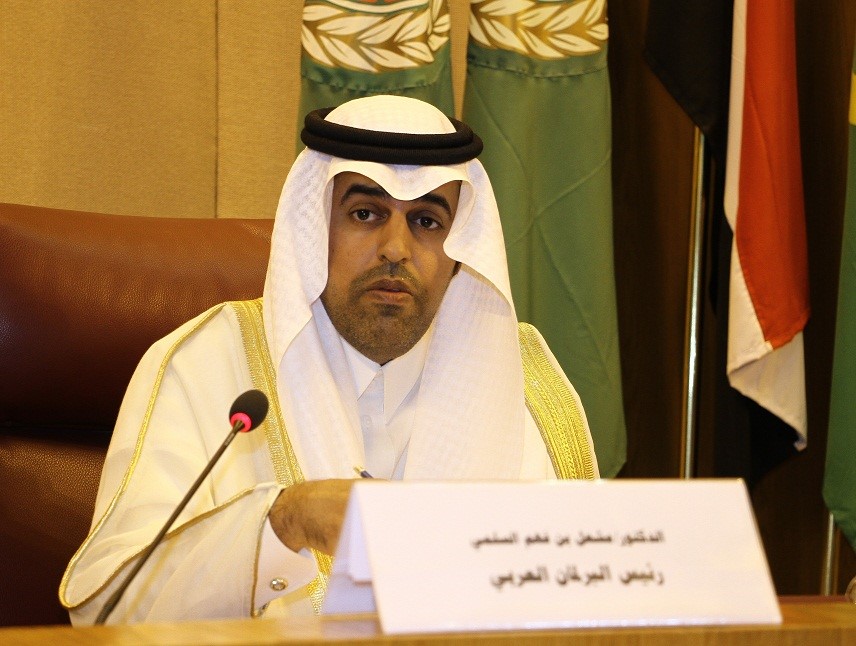
Arab Parliament Expresses Support for PRC Petition Demanding UK Apology for Balfour
London – 21 February 2017
Chairman of the Arab Parliament (AP), Dr. Meshaal AlSalmi, expressed his full support for a petition by the London-based Palestinian Return Centre (PRC) calling on the British government to apologize for the notorious Balfour Declaration, which pledged a homeland for the Jewish people in historic Palestine a century ago.
Speaking with PRC Executive Director, Tarek Hamoud, by phone, AlSalmi voiced AP’s back-up for underway endeavors to pressure Britain to make an apology for the Balfour pledge, vowing to take all necessary steps to that very end.
AlSalmi further promised to raise the issue with the British House of Commons, reiterating AP’s unyielding pro-Palestine standpoint.
For his part, PRC Executive Director, Mr. Tarek Hamoud, hailed AlSalmi’s position and expressed hope that AP’s backing would herald a turn for the better vis-à-vis the Palestinian cause.
The Cairo-headquarted AP was established following the adoption of Resolution 292 at the Arab League Summit held in Algiers in March 2005.