“Britain & Palestine: Balfour to Boris” Webinar Raises Alarm over Upshots of Balfour Declaration
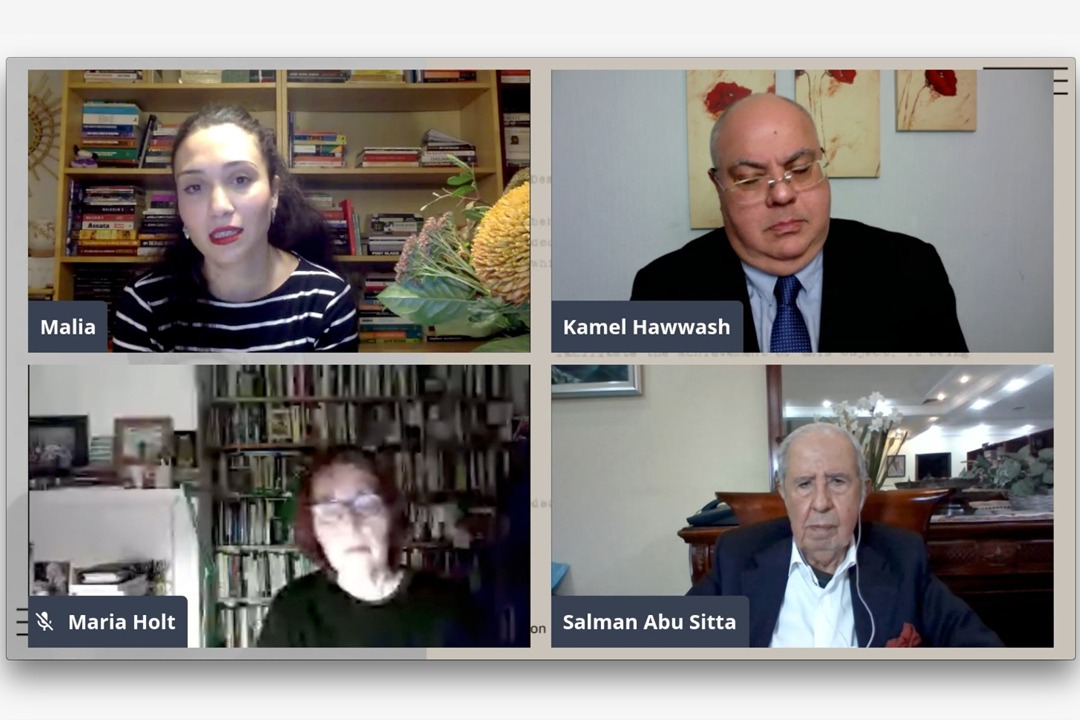
A webinar was hosted by the Palestinian Return Centre (PRC) on Monday 2nd November, 2020, from 7pm to 8:30pm, via Zoom video call to mark the 103rd anniversary of the Balfour Declaration.
Entitled “Britain & Palestine: Balfour to Boris”, the webinar underscored the tragic impact of the Balfour Declaration on Palestinian human rights for over a century, from 1917, when the notorious pledge saw the day, until the present moment.
The Webinar was chaired by Professor Kamel Hawwash, a British-Palestinian academic and writer. He is also the Chair of the Palestine Solidarity Campaign and a founding member of the British Palestinian Policy Council.
In his opening address, Mr. Hawwash introduced the Webinar’s first speaker, Dr Salman Abu Sitta, a Palestinian researcher most known for his ground-breaking mapping project on Palestine in the 21st, 20th and 19th centuries and for developing a practical plan for exercising the Palestinian right of return.
In his oral contribution, Dr. Abu Sitta focused on the history of the Balfour Declaration and the British colonial complicity in the ethnic cleansing, land theft and colonisation of Palestine, which had paved the way for the creation of Israel.
The second speaker was Dr. Maria Holt, a Senior Lecturer in the Department of Politics and International Relations at the University of Westminster. An outspoken political lobbyist and a parliamentary researcher specialising in the Middle East, Ms. Holt highlighted the devastating impact of the Balfour Declaration, saying the 103rd anniversary of the Declaration only serves as a stark reminder for the international community to speak up so loud for the Palestinian refugees’ plight and for their inalienable right of return to their homeland.
The discussion was wrapped up by a thorough contribution by activist Malia Bouattia—the former president of the National Union of Students, co-founder of the Students not Suspects/Educators not Informants Network, and presenter/panelist of British Muslim TV’s revolutionary talk show “Women Like Us”.
Ms. Bouattia’s speech covered the implication of the Balfour Declaration in terms of the geopolitical self-interests of colonial and imperialist powers back in 1917 up to the present decade.
“This is as much about freeing Palestine as it is about ending British and western imperialism”, stated Ms. Bouattia, as she unraveled her wish that the British government would assume its responsibility for the repercussions of the 1917 pledge, which she said was just one branch of Britain’s imperialistic tree.
The webinar culminated in a consensus that current British Government is historically, morally, and politically compelled to apologise for the Balfour Declaration and sever all diplomatic ties with Israel until the military occupation of Palestine is brought to a halt, international law is observed, and Palestinian refugees’ right of return materializes on the ground.
On Its 103rd Anniversary… Balfour Pledge Serves as Reminder of Achievements of PRC’s “Apology Campaign”
The efforts made by the London-based Palestinian Return Centre (PRC) have been making headway over recent years to urge Britain to apologize to the Palestinians for the tragedy that has befallen them as a result of the Balfour Declaration.
The Balfour Declaration, which was issued on November 2, 1917, resulted in nearly 7 million Palestine refugees being scattered all over the world, torn from the nourishment of home and the warmth of family.
The declaration turned the Zionist aim of establishing a Jewish state in Palestine into a reality when Britain publicly pledged to establish “a national home for the Jewish people” there.
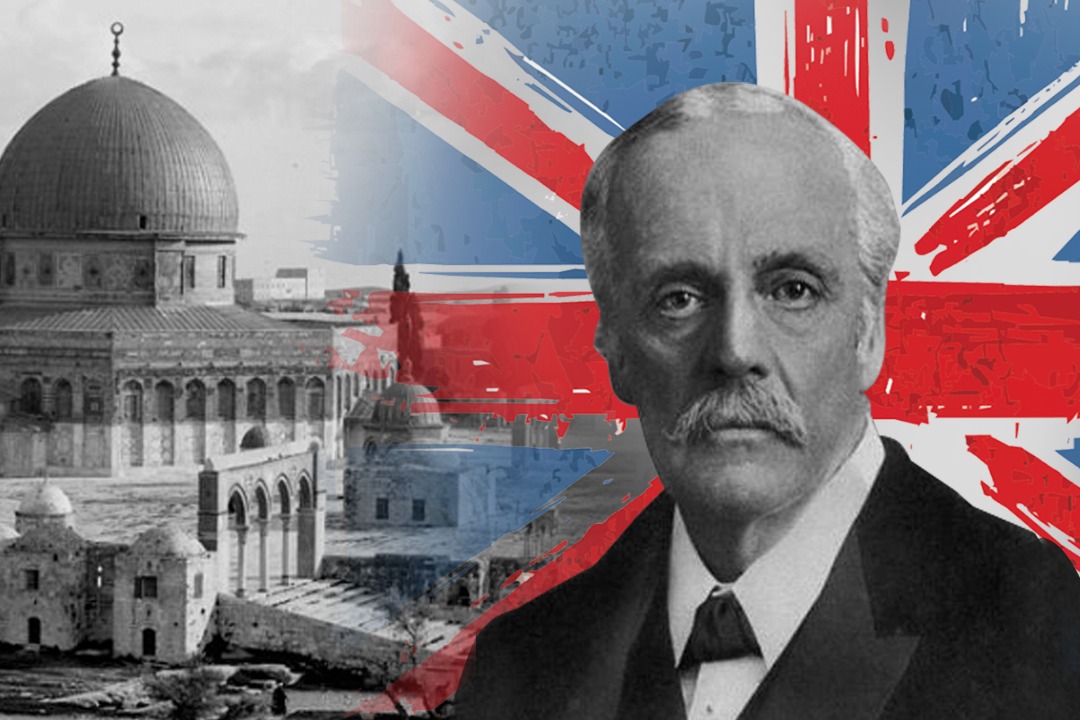
The pledge came in the form of a letter from Britain’s then-foreign secretary, Arthur Balfour, addressed to Lionel Walter Rothschild, a figurehead of the British Jewish community.
Though the Balfour Declaration included the admonition that “nothing shall be done which may prejudice the civil and religious rights of existing non-Jewish communities in Palestine”, the British mandate was set up in a way to equip Jews with the tools to establish self-rule, at the expense of the Palestinian Arabs.
Balfour Apology Campaign
The Balfour Apology Campaign (BAC), which was launched by PRC in 2017, dovetails ongoing endeavors to hold Britain historically, morally, and politically accountable for the dispossession and displacement of 750,000 civilians from their own and only homeland—Palestine—to give way for the establishment of the self-proclaimed state of Israel.
Reaching out to a plethora of British and EU diplomats and MPs, PRC has been striving to mobilize worldwide support for the campaign and communicate its demands to official bodies, mainly the British government.
In 2017, an e-petition headed up by PRC and launched on the official website of the British Parliament, attracted fewer than 14,000 signatures by British nationals. Duty-bound to respond to the petition, after it managed to pass the benchmark for an official response, the never-sorry government responded 10 days later, only to confirm that it will not extend any apology over the Balfour pledge.
Yet, the Government’s statement accepted that the Declaration “should have called for the protection of political rights of the non-Jewish communities in Palestine, particularly their right to self-determination” but said that lasting peace must now be established through a two-state solution.
The acknowledgement that the Balfour Declaration resulted in a violation of Palestinian rights represents an unprecedented confession in the history of the UK government, with many academics and political analysts viewing the confession as a sign of imperialistic narcissism that hides an undoubtful feeling of guilt.
At the same time, Britain’s letter has been read as a sign of its failure to confess to to the horrendous crimes committed by Zionist gangs who crept into Palestine during the British Mandate and embarked on systematic massacres and ethnic genocides that brought about the displacement of millions of Palestinians from over 570,000 Palestinian villages in 1948.
As BAC campaigners sought to pass the 100,000 yardstick for a parliament discussion, the parliamentary follow-up committee abruptly altered the cut-off date, reducing it from six months to two months and a half only under the guise that snap elections had been called.
First World War Conference
In 2013, a conference was staged by BAC under the title “The Legacy of Britain in Palestine”. The event spotlighted Britain’s imperialistic history and its ideology-motivated policies in Palestine.
The conference tackled the impacts of the First World War and the repercussions of the ensuing political agreements on Palestinian land and rights.
The conference culminated in a book comprising a bundle of research papers by academics, diplomats, and researchers who took part in the event.
“Balfour Road” Movie
PRC re-introduced the campaign during a seminar hosted by Baroness Jenny Tonge in response to Britain’s attempt to celebrate the centenary of the Balfour Declaration. The seminar was chaired by Lord Norman Warner.
A short movie bearing the title “The Road to Balfour” and released on October 30, 2017, draw the world’s attention to the calamitous repercussions of the Balfour Declaration.
Available in 17 different languages (English, Arabic, Spanish, Danish, Dutch, Swedish, Polish, Italian, Turkish, Hindi, Urdu, Farsi, Chinese, Russian and Indonesian) and broadcast in 25 cities around the globe, the film puts on display the story of a British family who are driven out of their home by the British government and forced to live in a cramped shack in the backyard. Another family—the Smiths—take possession of the house and put down roots in the building, leaving the real house owners—the Johnees—with neither food nor medicines. Heavily-armed soldiers escort the Smiths at the same time as they tighten the noose around the neck of the Johnees and deprive them of their basic rights. The film was premiered inside Queen Elizabeth Hall in London.
E-Memorandums
An online platform was also launched by BAC campaigners to pass on e-memorandums and give the floor to pro-Palestine activists from around the world to speak up their minds, indirectly address the British government, and urge the Royal Albert Hall to backtrack on its decision to host a centennial celebration of Balfour Declaration.
The move garnered widespread back-up as in no more than three days over 11,000 memos were dropped into the email of Royal Albert Hall.
Ongoing Efforts
Dozens of seminars/webinars and meetings have been convened by PRC in London and other European cities, in tune with its ceaseless endeavors to speak up for Palestinians’ inalienable rights.
Through its fruitful involvement in the UNHRC’s sessions, PRC continues to draw the attention of a consortium of NGOs, EU diplomats, prominent activists, and influential high-ranking stakeholders to the intrinsically-monolithic character of the Balfour Declaration and its tragic consequences on the Palestinian people.
PRC
The Palestinian Return Centre (PRC) is an independent, non-partisan, organization committed to advocating for the rights of Palestinian refugees, in accordance with the historical, political and legal basis of the right to return.
PRC educates the public, defends human rights, and empowers Palestinian refugees, in order to put the plight of the refugees back on the political agenda.
Although the PRC is Palestinian in origin, it is not affiliated with any particular organization or party. It works on the assumption that the plight of the Palestinians is not just a national liberation movement but is, in essence, about the core values and ideals that are at the centre of any human civilization and international law.
In July 2015, PRC was granted consultative status at the United Nations as a Non-governmental organization (NGO) in special consultative status with the Economic and Social Council (ECOSOC), in recognition of its efforts in standing up for Palestinian human rights.
PRC Actively Engaged in Balfour Apology Campaign for 6th Year Running
As the fallouts of the notorious Balfour Declaration, made in 1917, continues to ruin Palestinians’ present and future as an incurable cancer does a man’s vulnerable body, efforts have been under full swing to urge Britain to make an official apology to the affected peoples, particularly, but not exclusively, the Palestinians.
Though an apology never ends up healing the grave wounds inflicted on a people’s memory and history, it is, nonetheless, a moral, historical, and historical debt that the “offender” owes to the “victim.”
The efforts made by the London-based Palestinian Return Centre (PRC) in this regard have been on the go over recent years to urge Britain to apologize to the Palestinians for the tragedy that has befallen them as a result of the Balfour Declaration, a letter sent by the UK’s Foreign Secretary Arthur Balfour to Lord Rothschild, a leader of the British Jewish Community, green-lighting the establishment in Palestine of a national home for the Jewish people.
The Balfour Apology Campaign (BAC), kick-started by PRC some six years ago, falls exactly within the above context as it matches ongoing endeavors to hold Britain historically, morally, and politically accountable for the dispossession and displacement of 750,000 civilians from their own and only homeland—Palestine—to give way for the establishment of the self-proclaimed state of Israel.
As a result, nearly 7 million Palestine refugees have become scattered all over the world, torn from the nourishment of home and the warmth of family.
Ever since the pledge saw the day, the Palestinians have seen it all. Extrajudicial murders, mass genocides, arbitrary abductions, administrative detention (sentence with neither charge nor trial), racial discrimination, religious persecution, and home demolitions, among dozens of other internationally-condemned crimes, have been among the violations perpetrated by the Israeli occupation forces and authorities against the Palestinian people.
At the same time, an eleven-year-long blockade on the Gaza Strip has made life quite unbearable in the enclave, turning in it to what has been referred to as the world’s “largest open-air prison”.
The Palestinians have also been denied their basic and most precious rights, namely the internationally-recognized right to self-determination.
Advocacy Mechanisms
A set of tools and mechanisms have been implemented by BAC, which came into being by the end of 2012, in order to step up pressure on the UK government and push it to confess to its historical responsibility over the upshots of the anti-Palestine promise.
Reaching out to a plethora of British and EU diplomats and MPs, PRC has been striving to mobilize worldwide support for the campaign and communicate its demands to official bodies, mainly the British government. Contacts have been held around the clock with NGOs, youth movements, and student events to that very end.
First World War Conference
In 2013, a conference was staged by BAC under the title “The Legacy of Britain in Palestine”. The event spotlighted Britain’s imperialistic history and its ideology-motivated policies in Palestine.
The conference tackled the impacts of the First World War and the repercussions of the ensuing political agreements on Palestinian land and rights.
The conference culminated in a book comprising a bundle of research papers by academics, diplomats, and researchers who took part in the event.
BAC Steps up Pressure
PRC re-introduced the campaign during a seminar hosted by Baroness Jenny Tonge in response to Britain’s attempt to celebrate the centenary of the Balfour Declaration. The seminar was chaired by Lord Norman Warner.
A short movie bearing the title “The Road to Balfour” and released on October 30, 2017, draw the world’s attention to the calamitous repercussions of the Balfour Declaration.
Available in 17 different languages (English, Arabic, Spanish, Danish, Dutch, Swedish, Polish, Italian, Turkish, Hindi, Urdu, Farsi, Chinese, Russian and Indonesian) and broadcast in 25 cities around the globe, the film puts on display the story of a British family who are driven out of their home by the British government and forced to live in a cramped shack in the backyard. Another family—the Smiths—take possession of the house and put down roots in the building, leaving the real house owners—the Johnees—with neither food nor medicines. Heavily-armed soldiers escort the Smiths at the same time as they tighten the noose around the neck of the Johnees and deprive them of their basic rights. The film was premiered inside Queen Elizabeth Hall in London.
An online platform was also launched by BAC campaigners to pass on e-memorandums and give the floor to pro-Palestine activists from around the world to speak up their minds, indirectly address the British government, and urge the Royal Albert Hall to backtrack on its decision to host a centennial celebration of Balfour Declaration.
The move garnered widespread back-up as in no more than three days over 11,000 memos were dropped into the email of Royal Albert Hall.
In 2017, an e-petition headed up by PRC and launched on the official website of the British Parliament, attracted fewer than 14,000 signatures by British nationals. Duty-bound to respond to the petition, after it managed to pass the benchmark for an official response, the never-sorry government responded 10 days later, only to confirm that it will not extend any apology over the Balfour pledge.
“The Balfour Declaration is an historic statement for which HMG does not intend to apologize,” the government said at the time. “We are proud of our role in creating the State of Israel. The task now is to encourage moves towards peace.”
A spokesperson said the Declaration was written in a world of “competing imperial powers” as the First World War raged and Ottoman Empire diminished, claiming: “In that context, establishing a homeland for the Jewish people in the land to which they had such strong historical and religious ties was the right and moral thing to do, particularly against the background of centuries of persecution.”
Yet, the Government’s statement accepted that the Declaration “should have called for the protection of political rights of the non-Jewish communities in Palestine, particularly their right to self-determination” but said that lasting peace must now be established through a two-state solution.
The response sparked universal condemnation, with activists and NGOs dubbing it as a sign of Britain’s failure to pay heed to the horrendous crimes committed by Zionist gangs who crept into Palestine during the British Mandate and embarked on systematic massacres and ethnic genocides that brought about the displacement of millions of Palestinians from over 570,000 Palestinian villages in 1948.
As BAC campaigners sought to pass the 100,000 yardstick for a parliament discussion, the parliamentary follow-up committee abruptly altered the cut-off date, reducing it from six months to two months and a half only under the guise that snap elections had been called.
Challenges and Achievements
Over the past six years, BAC has been subjected to ad hominem campaigns waged by the Israeli Lobby.
Baroness Jenny Tonge was made to step down from her post, amid an outcry of her anti-Israel rhetoric. Counterfeit accusations were filed against her by the Israeli Embassy and other pro-Israel media outlets. The accusations were triggered by the event she hosted at the House of Lords that featured critical observations about the Balfour Declaration of 1917, in which the United Kingdom committed to viewing favorably the establishment of a Jewish national home in what would later become the British Mandate on Palestine.
Sometime later, the Parliamentary Committee for Privileges and Conduct dismissed allegations of anti-Semitism against Baroness Jenny Tonge for hosting the launch of the Balfour Apology Campaign on October 25th 2016, in the House of Lords.
It was alleged that Jenny Tonge has breached the Code of Conduct, which requires members to act on their personal honor but the Committee has decreed resounding results, proving that Baroness Tonge did not breach the Code of Conduct in her hosting and chairing of the meeting on the parliamentary estate.
The false accusations of anti-Semitism from the media and the Israeli Embassy were categorically refused by the Committee for Privileges and Conduct, and the investigation refuted as well the claim that the comments made by the member of the Naturei Karta amounted to ‘Holocaust denial’.
In the meantime, dozens of seminars and meetings have been convened by PRC in London and other European cities, in tune with its ceaseless endeavors to speak up for Palestinians’ inalienable rights.
Through its fruitful involvement in the UNHRC’s sessions, PRC has managed to draw the attention of a consortium of NGOs, EU diplomats, prominent activists, and influential high-ranking stakeholders to the intrinsically-monolithic character of the Balfour Declaration—the promise of he who does not own to those who do not deserve it.
PRC:
The Palestinian Return Centre (PRC) is an independent, non-partisan, organization committed to advocating for Palestinian refugees, in accordance with the historical, political and legal basis of the right to return.
PRC educates the public, defends human rights, and empowers Palestinian refugees, in order to put the plight of the refugees back on the political agenda.
Although the PRC is Palestinian in origin, it is not affiliated with any particular organization or party. It works on the assumption that the plight of the Palestinians is not just a national liberation movement but is, in essence, about the core values and ideals that are at the centre of any human civilization and international law.
In July 2015, PRC was granted consultative status at the United Nations as a Non-governmental organization (NGO) in special consultative status with the Economic and Social Council (ECOSOC), in recognition of its efforts in standing up for Palestinian human rights.
Lord Warner hosts PRC for Parliamentary event on ‘Palestine and the Balfour Declaration’
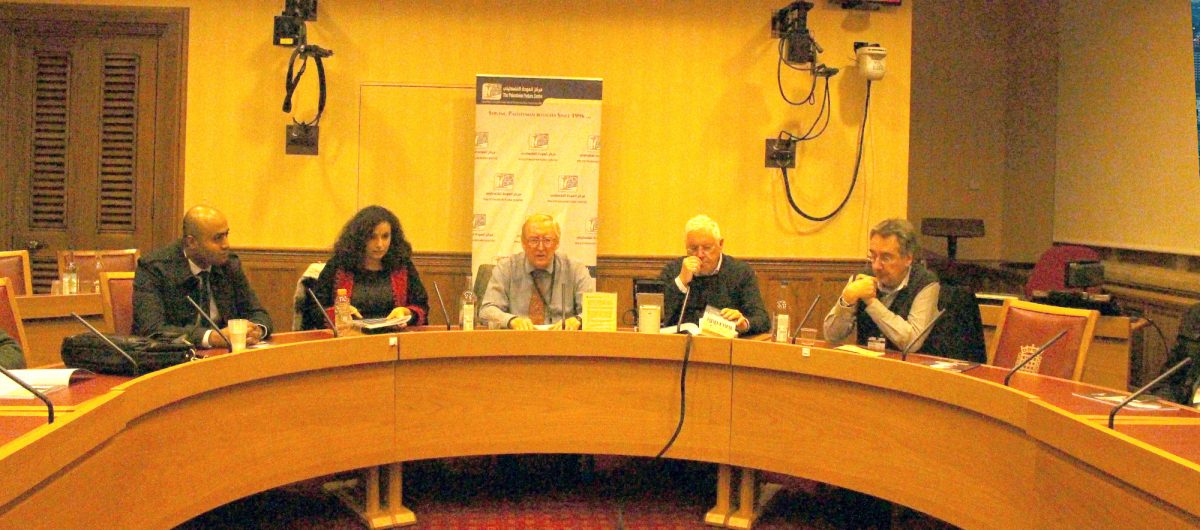
(London) – The Palestine Return Centre (PRC) organized a parliamentary meeting in the Houses of Parliament on the 20th of November titled “Palestine and the Balfour Declaration”, hosted and chaired by Lord Norman Warner, a cross-bench peer, and a Labour health minister between 2003 and 2007.
The speakers at the event included Salma Karmi-Ayyoub, barrister and legal consultant for the Palestinian human rights organisation Al Haq; Bernard Regan, author of The Balfour Declaration: Empire, the Mandate and Resistance in Palestine, and John Rees, historian, broadcaster and campaigner. He is a Visiting Research Fellow at Goldsmith’s, University of London and a National Officer of the Stop the War Coalition.
Each speaker approached the topic of Palestine and the Balfour Declaration from a specialist angle. Bernard Regan provided the context of the creation of the Declaration, focusing on the discussions that took place in the cabinet around the time of its foundation. Regan drew attention to Britain’s main objective in the Declaration; that is the pursuit of Britain’s imperial interests rather than a concern for the welfare and safety of the Jewish population. Regan described the Declaration as a “marriage of convenience between the British and Zionism,” while emphasizing that the decision to create the Declaration was not unanimous.
John Rees further highlighted the presence of alternative voices, pointing out that supporters of Israel would like to portray the creation of its state as “inevitable or uncontested. But the Balfour Declaration allows us to see that the establishment of Israel was neither of those two things.” Indeed, John Rees drew attention to the fact that the Declaration was contested at the highest level in the cabinet by Edwin Samuel Montagu, the third practicing Jew to ever serve in the British cabinet. Montagu’s prophetic remarks that the Zionist project would lead to a displacement of Palestinians, and that there would be a backlash against the Jewish population, were not listened to – not least due to the anti-Semitic attitudes in the cabinet. John also highlighted that British policy wasn’t only backing the Zionist project. T.E. Lawrence was apparently promising the same land to the Arab population in order to advance their project in the Ottoman Empire, illustrating Britain’s method of using any indigenous population to advance their imperial policies – which to this day causes instability and shifting alliances in the Middle East.
Salma Karmi-Ayyoub used her platform as an opportunity to reflect on what she found to be the root causes of the Arab-Israeli conflict, and stressed that there is a need for a paradigm shift in our way of thinking about Israel;
“We should move away from the notion that Israel is a state that is guilty of numerous human rights abuses, towards the notion that Israel has an unlawful regime.”
Karmi-Ayyoub highlighted that the root of the conflict comes down to contradictions between the right of Palestinian people for self determination and the ‘Jewish Project’; the privileging of Jews over other populations in order to create a Jewish majority state. The ‘problem’ arises with the indigenous population, which resulted in ethnic cleansing and a wholesale of Palestinian property. The consequence is thus the maintenance of a regime of racial discrimination of Palestinians inside both historical Palestine and the occupied territories.
Salma Karmi-Ayyoub made a key reference to a 2004 International Court of Justice report[i], which issued an advisory opinion that Israel’s building of a barrier in the occupied Palestinian territory is illegal, that construction must stop immediately and Israel should make reparations for any damage caused. Although these are important recommendations, and Israel is de facto seen as having an unlawful regime, Karmi-Ayyoub suggested that the legal community must go a step further and explicitly state that the occupation itself is illegal, and as an extension of Israeli government practices, would make Israel an illegal regime.
When a regime is deemed ‘unlawful’, international law dictates that states are obliged to not recognize the regime, and work to end it. However, practical UK foreign policy actively supports the arms trade, supports settlement produce, and, crucially, provides diplomatic cover for Israel. UK foreign policy is thus “unlawful under standards of international law”, Karmi-Ayyoub stressed, and urged supporters of Palestine to change their view of Israel in order to move the UK government to take their words into action.
To summarise, Lord Norman Warner facilitated a stimulating discussion amongst the audience and offered the speakers a chance to share their closing remarks. Salma Karmi-Ayyoub again stressed the importance of a paradigm shift, and suggested that perhaps a new generation with a new vision will be able to find unforeseen solutions. For the moment, she encouraged supporters of Palestine to adopt BDS, respecting the wishes of the Palestinian people. John Rees finished off with a similar sentiment, quoting the adage that “wars and revolutions are unforeseeable before they happen, and inevitable after they happen”. Bernard Regan emphasized the importance of international solidarity, also inviting supporters of Palestine to join the Palestine Solidarity Campaign, the BDS campaign, and pay attention to the needs of people in Palestine.
Lord Norman Warner lastly drew attention to the fact that the British government has still not recognized the state of Palestine, and criticized the difficulty with which Parliamentarians can visit Gaza.
[i] http://www.un.org/apps/news/story.asp?NewsID=11292#.WhQGV9SLTGg

100 Balfour Road
This film, produced by the Palestinian Return Centre (London) and the Balfour Apology Campaign, puts on view the tragic fallouts of the Balfour Declaration (1917), in which the British Foreign Secretary Arthur Balfour signalled the go-ahead for the establishment of a Jewish State in Palestine.
Available in 18 different languages: English, Arabic, Spanish, French, German, Danish, Dutch, Swedish, Polish, Italian, Turkish, Hindi, Urdu, Farsi, Chinese, Russian, Indonesian and Malay.
Produced by: ima6ine
Written By
Richard Beer
CAST
Tim Bartholomew as Arthur Balfour
Tom Coulston as Father – Joneses
Hayley Sheridan as Mother – Joneses
Chloe Zelkin as Alice
Henry Lile as Adam
Anna Ray as Mother – Smiths
Andrew Shire as Father – Smiths
Lily Hannigan as Daughter – Smiths
Ivo Dickason as Son – Smiths
Directed By
Anas al-Karmi
Assistant Director
Abdul Mu’ti AlTirawi
Audiographer
Ammar AlZeer
Prepared By
Ali Faraj
Produced By: The Palestinian Return Centre © 2017
100 Balfour Road is out now
WATCH NOW
100 Balfour Road
One Letter, A Hundred Years of Injustice and Opression!
A Short Film by
The Palestinian Return Centre and Balfour Apology Campaign
Why 100 Balfour Road?
Can we still be held hostage by the actions of our past? Is it possible for a decision to mean well for a group and brutally impoverish another? The answers you seek lies in “100 Balfour Road” as the movie brings to you the visual effects of the Balfour Declaration of 1917.
The declaration was a power statement made by Lord Arthur Balfour in 1917 to the leaders of the British Zionist community granting them the power to establish a national home for the Jewish community in Palestine.
This statement was made without any consideration of the people of Palestine, the Palestinian leadership was not represented in the meetings that led to the declaration and the people of Palestine were referred as “ non- Jewish” even when their comfort and sovereignty as a nation were at stake.
This declaration changed the history of Palestine, putting to sword the relative peace in that region and giving birth to years of conflict, war, oppression, displacement and even death of thousands of Palestinian lives.
This year makes it one century since the obvious dangerous decree was made and the effects are still living with us today, the displacements and operation that followed the declaration are still imminent. There are over 7 million Palestinian refugees living in abject poverty all over Palestinian territories, Jordan, Lebanon, and even Syria.
Major cities of Palestine origin as a still held hostage or colonized by settlers legalized by the declaration, an example is the city of Gaza and the west bank which is still under military occupation for over 50 years.
We all owe Palestine a heartfelt apology, especially the British government for the calamity the Balfour declaration brought to their country. The British government should take responsibility for their actions acknowledge their role in fueling one of the most brutal ethnic cleansing that followed the Balfour Declaration. Although severe damage has been done as a result of the declaration, rendering a heartfelt apology will help heal the wound faster.
Read the release press statement: https://prc.org.uk/en/post/3775/

Demand Royal Albert Hall to Cancel a Celebration of Balfour Declaration Centenary
Balfour Apology Campaign and the Palestinian Return Centre urge you to write to the Royal Albert Hall to protest against the hosting of a celebration of the centenary of the Balfour Declaration.
The Balfour 100 Ltd group, formerly known as “United Christian Alliance For Israel” have organised an event at the Royal Albert Hall on November 7th 2017, to the celebrate the centenary of the Balfour Declaration.
The event is portrayed as merely a musical event, but it is clearly politically motivated and its principal aim is to encourage support for the state of Israel to continue its crimes against Palestinians with impunity.
We ask you to take action against this! Fill in the form below and click the send button to ask them to cancel the event. Or alternatively, copy and paste the text and input it in this link: https://www.royalalberthall.com/your-visit/contact-us/ >
You may also use the tweets at the bottom of this link: https://prc.org.uk/en/campaign/2/demand-royal-albert-hall-to-cancel-celebration-balfour-declaration-centenary to tweet directly to their official twitter account and express your position openly.

The Palestinian Return Centre Announces The Opening Of “100 Balfour Road” For Public Release
The Palestinian Return Center today, on the 30th of October, announces the release of the long-awaited short movie“100 Balfour Road” in the remembrance of the sufferings, displacement, and deaths of thousands of Palestine lives caused by the Balfour declaration 100 years ago.
“100 Balfour Road” upon release is available in 17 different languages: English, Arabic. Spanish, Danish, Dutch, Swedish, Polish, Italian, Turkish, Hindi, Urdu, Farsi, Chinese, Russian and Indonesian. Produced by ima6ine.
Watch the film here: https://youtu.be/vPndQGImVMc
The movie, produced as a part of the Balfour Apology Campaign by the Palestinian Return Centre, is available for free watch and can be reached on YouTube and PRC’s media platforms.
By this release, the Balfour Apology Campaign completes the 5th year working on major aim of getting the British government to apologize for their role in the Balfour Declaration in 1917 which led to the death and displacement of millions of Palestinian lives.
Since the inception of this campaign, it has actively hosted dozens of seminars and activities. In 2013, the campaign held a conference in London titled “Britain’s legacy in Palestine” to raise awareness on the failed policies of the British government in Palestine which have led to terrible human right abuse of the people of Palestine.
This conference examined the impact of World War I on Palestine, scrutinizes the various political agreements between different parties with an interest in the area through significant worksheets which formed a book carried the same title.
Balfour Apology Campaign, later on February 2017, formally launched a petition on the British parliament official website demanding the British government to openly apologize to the Palestinian people for issuing the Balfour Declaration. This petition was ruefully turned down by the British government.
Other activities by the Campaign include holding retreats and seminars inside the British Parliament discussing different aspects and consequences of Balfour Declartion, and lobbying the MPs and politicians to help move our course to the next level.
One of the latest activities is the petition to stop the Royal Albert Hall from being used as the venue for the celebration of the Balfour declaration centenary, this celebration is an insult to millions of Palestinians who are still either refugees out of their home land, or oppressed under occupation inside Palestine, needless to tell that the reason is the 1917 Balfour declaration.
Balfour Apology Campaign by PRC will not stop until a public apology is issued by the British government to the people of Palestine and a legal action is carried out to correct all the mishaps that have been triggered by the Balfour declaration.

PRC Protests to Sadiq Khan Against TfL’s Ban of a Palestinian Ad Ahead of Balfour Centenary
London 18th October 2017
The Palestinian Return Centre (PRC) has written a letter to the Mayor of London, Sadiq Khan to protest against Transport For London’s decision to ban advertisements displaying Palestinian objection to the Balfour Declaration.
PRC is extremely disappointed that TFL has refused to run the Palestinian Mission UK’s advocacy campaign that aims to raise awareness about the effects of the Balfour Declaration on the Palestinian people. It is a timely campaign that seeks to inform the British public of the gravity of the Balfour Declaration, which was instrumental to the forced expulsion of the Palestinian people and to their suffering ever since it was declared.
The advertising campaign was allegedly rejected under clause 2.3 (h) of the Advertising Policy, referring to “images or messages which relate to matters of public controversy or sensitivity”. However, we would like to emphasize the remainder of the same clause which states “advertisements which are calculated to promote the right to life, liberty and security of the person, and advertisements which reasonably promote causes which are not party political, will however not normally be disapproved on this ground”. The campaign is wholly factual in content and voices the abuse of rights of the Palestinian people with the purpose of calling attention to their liberty, or lack thereof.
Additionally, we seriously question the rejection of the advertising campaign under this clause, given the TFL’s support of a 12-month BAE systems campaign at Westminster tube station. BAE systems have been known to supply Israel with ‘Head-Up Displays’ (HUD) for F16 fighter aircrafts, which have been used by the Israeli army to destroy Lebanese and Palestinian villages and towns into rubble. BAE system’s products also include radar systems, handcuffs and shackles used in Guantanamo Bay and Saudi Arabia. TFL and Greater London Authority’s Sponsorship explicitly states under clause 5.5 (f) that “The Authority will not enter into agreements for sponsorship from organisations deriving income from pornography, or immoral activities.”
Britain has a legal and moral responsibility to take tangible restorative action and give the Palestinians basic rights and self-determination, but this ban only acts to censor the Palestinian narrative. We condemn the decision to reject this advertising campaign, and urge you to reverse this ban in the interest of promoting the right to life, liberty, and security, as is set out in TFL’s Public Sector Equality Duty 5.5 (f).

Launch of the Balfour Apology Campaign: Join us in the House of Lords on October 25th
The Palestinian Return Centre (PRC) invites you to the
House of Lords
to discuss the Launch of the Balfour Apology Campaign: Time to Say Sorry
The Palestinian Return Centre is hosting an event inside the UK Parliament a week ahead of the 99th anniversary of the Balfour Declaration which will be on November 2nd. The Balfour Declaration, which had no basis of legal authority, promised the establishment of a Jewish state in Palestine, where the indigenous Palestinians amounted to 90% of the total population.
After the Balfour Declaration Palestine became the victim of colonialism and Britain’s legacy is still evident today as Palestinians continue to be denied the right to self-determination and suffer from living under military occupation or as refugees. As the 100th year since the Balfour declaration approaches, the Palestinian Return Centre has decided to re-launch its campaign which started in 2013 called Balfour Apology Campaign which asks the UK Government to officially apologies for its past colonial crimes in Palestine.
Committee Room 2a, Houses of Parliament
Tuesday 25th of October at 7pm Hosted and chaired by Baroness Jenny Tonge
Panel Includes
Professor Manuel Hassassian, Ambassador of the Palestinian Mission to the UK
Betty Hunter, Honorary President of Palestine Solidarity Campaign
Britain’s legal and moral obligation
Karl Sabbagh, Historian and Writer
How successive British governments fell in love with Zionism, until it was too late
Majed Al-Zeer, President of the Palestinian Return Centre
On the Balfour Apology Campaign
More speakers to be announced
Register by email: info@prc.org.uk