
Press Release: 9 decades of Balfour Declaration; Palestine still there
The Palestinian Return Centre (PRC) remembers the Balfour Declaration after more than 9 decades. It asserts that it’s the time now to end the Palestinian plight and grant the full rights for the Palestinians. For nearly a century, 2nd of November is marked for somber reflections on the inequity and injustice caused by the Balfour Declaration made on November the 2nd 1917.
The infamous declaration, named after Britain’s then Foreign Secretary, Arthur James Balfour, leader of the British Jewish community, paved the way for the loss of Palestine and the creation of Israel at the expense of Palestine state.This declaration resulted in tremendous injustices on the Palestinians mainly through the Nakba in 1948, which has now lead to the exile of millions of Palestinians as floods of Jewish migration streamed into Palestine to replace an entire nation. For that reason the declaration is universally condemned.This unfair promise tainted the history of Palestine. Another offense, which comes a close second, is the many illegitimate declarations and negotiations, like Balfour, made without a mandate from the people but nevertheless seal the fate of the Palestinian people. The Oslo agreement, and Obama’s acquiescence in declaring Israel a Jewish state, are all recent examples of unauthorized agents acting to compromise human rights of the Palestinians.The declaration has been rightly condemned on many fronts. In addition to exposing its feeble moral and legal grounds on which it is based, its imperial intent is also mooted, not to mention of course the glaring inconsistency in Britain’s application of its own policy.The tragic truth is that, since its declaration, Palestinians have suffered incalculable number of prejudice that has denied their every right. The other sobering fact is that the accumulated injustices, as long as they persist, will not engender peace. Britain and its major allies have a real moral and strategic interest to reverse this historical injustice.“The Palestinian Return Centre, calls on everyone to stand in solidarity with the Palestinian people, on this day which they mark with sadness and grief” said Mr Al Zeer, Director of the Palestinian Return Centre (PRC). “We; like hundreds of Palestinian originations and parties around the world call on Britain to undo this historical injustice and apply its own stated values and principals without discrimination”.

Petition to David Cameron: Calling for any Apology/Action on Balfour Declaration
Balfour Declaration is a day that will be written for ever in the history of Palestine and its people. In November the 2nd each year we remember this black day. This year is 93rd anniversary of the Balfour Declaration. We shall remember it with actions not only words.We shall not forget the suffering and pain resulting as a consequence in this tragic event. Balfour Declaration is an event that caused the dispossession and killing of Palestinians till now. Successive British governments have neither apologized nor pressured for a genuine solution for the Palestinian cause.
We, the Palestinian Return Centre, Palestinian Community in the Uk and Palestinian Forum in Britain; started this petition initiative to push current British government to recognize its historical failure in Palestine.
It is also to urge the government to play a more active role in promoting justice and human rights. Additionally, we are calling for an apology and to defend the rights and properties of British Palestinians. Anyone over the age of sixteen and, is British of Palestinian origin is encouraged to complete the petition. In order to receive a written response from the Prime Minster we need at least 1000 signatures so please encourage your family and friends to sign the petition.
To sign this petition you can complete the online petition form below:
http://www.gopetition.com/petition/40891.html
The full text of the petition:
To the Right Honourable David Cameron MP
Dear Prime Minister,
We the undersigned British of Palestinian origin appeal to HM Government, in recognition of its historical role in the ongoing plight of Palestinians, to take historic steps in ending it.
November the 2nd will mark the 93rd anniversary of the Balfour Declaration. This declaration is the main symbol of Britain’s failed policy in Palestine. The turbulent effects of this failure still remain with us and Palestinians more than any other have been the victims. For decades Palestinians have suffered from endless wars, experienced massacres and were forced to flee from their land. Now, after 93 years, 7.1 million Palestinians, three quarters of the population, have been made refugees. Most are living on handouts from the international community, many facing intolerable pain and suffering on a daily basis. They see no end to their suffering as Israel continues, in an affront to international law and justice, to change facts on the ground by taking more land, building more settlements and imprisoning 1.7 million Palestinians in Gaza.
The real tragedy Mr. Cameron is not that Palestinians are suffering, it is that they have suffered for so long, even though the moral and legal weight have been on their side right from the beginning, and the international community have failed miserably to correct the historical injustice. The right of Palestinians to return to their lands is enshrined in the Universal Declaration of Human Rights, The International Convention on the Elimination of all Forms of Racial Discrimination, The International Convention on Civil and Political Rights. Right of return is guaranteed under Humanitarian and Human Rights Law and including countless UN resolutions.
Palestinian rights were further reinforced, In July 2004, by the International Court of Justice (ICJ), when the ICJ was tasked by the UN General Assembly to issue an advisory opinion on the Legal Consequences of Construction of a Wall in the Occupied Palestinian Territory. This was an unprecedented moral and legal victory for the Palestinian cause. However, six years on, instead of finding a more chastened Israel we find a more hostile Israel, demonstrating impunity for international law and displaying yet more aggression against the Palestinians.
Mr. Cameron we are not calling on HM Government to side with the Palestinians but to side with the moral and legal positions that are unequivocally made by the highest judicial body in the world and countless human rights organisations. This is the least any citizen can demand from their government that is committed to law, justice and human rights.
We greatly appreciate your stance on Gaza and the Flotilla. And we were very encouraged by many of your MPs who also held a very strong moral and legal position following the attack on the flotilla. Your coalition partners, including the Deputy Prime Minster Nick Clegg, have written and voiced their concern over Israel’s deep hostility towards the Palestinians. Not only is it immoral and illegal it is also dangerous for the region, the international community and of course Britain.
We need a new politics for our foreign affairs, a new politics that leans towards greater justice and human rights. This coalition government has an opportunity to start that. Mr. Cameron the long arc of history may still judge the British position favourably; In Palestine our story could be a tale of redemption and reconciliation and not just as a flawed and duplicitous imperialist. The words you speak and the position you take from now can turn a new page in Britain’s role in Palestine. The next four years in office is an opportunity for you to remake this history and reposition Britain as a voice for justice, peace and human rights in the region.
History will judge Britain favourably in the region only when Britain plays a major part in ending the suffering of Palestinians. This can only begin when Britain apologises for its role in this affair and becomes visibly active in undoing the injustices of the past six decades. A courageous step will be made when our Prime Minster defends the rights and properties of British citizens who fled violence and persecution in Palestine. These citizens still hold deeds to their land in Palestine but still they have been denied their right to return to their land and reclaim their home from which they were expelled.
The petition prepared by:
The Palestinian Return Centre (PRC)
Palestinian Forum in Britain
Palestinian Community in the UK
Palestinian Return Centre (PRC)
100H Crown House, North Circular Road
London NW10 7PN
Tel: +44 20 84530919
Fax: +44 20 84530994
Email: info@prc.org.uk
website: http://www.prc.org.uk
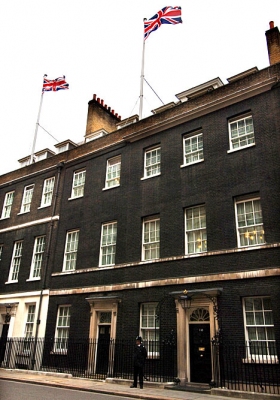
PRC urges British government to accept historical responsibility for consequences of Balfour Declaration
The London based Palestinian Return Centre (PRC) today forwarded letters of concern to Prime Minister Tony Blair and members of the British parliament to mark the 84th anniversary of the Balfour Declaration.
In his letter to Blair, Chairman of the Return Centre, Majed Al Zeer wrote, “the Balfour Declaration may have been a victory for ‘the people without a land’ but it was also a national tragedy for the Palestinian people” because it failed to ensure the emergence of a Palestinian state that guaranteed citizenship for all its inhabitants.
The Declaration according to the PRC “facilitated the establishment of a Jewish State on 78% of Palestine, contrary to the wishes of its people and the UN Partition Plan.” After expelling three-quarters of the Palestinian population, Israel has since exploited its friendship with Britain to belligerently occupy what remained of historic Palestine. Al Zeer stressed the greatest contribution Britain can offer to the cause of peace in the Holy Land today is to ensure the return of the Palestinian refugees to their homes from which they were expelled.
He added “The British Government might consider it particularly appropriate, at this time, to make some verbal gesture of acknowledgement of the historical responsibility that Britain bears for the creation of the refugee crisis that continues today.”
“While we recognize the importance of securing a ‘closure’ of the conflict we maintain that this cannot be achieved before the full restoration of Palestinian national rights. We, therefore, add our voice to the groundswell of public opinion that demand the suspension of British military and economic cooperation with Israel until it fulfills its international obligations toward the Palestinian people.”
In its letter to the parliamentarians, the PRC decried what started as a “national home” project in 1917 and has since developed into a state that enjoys virtual immunity from international law. It affirmed the fact that Palestinians accounted for more than half of the world’s refugee population is not only an indicator of the scale of their human tragedy but equally of the enormity of political effort needed to end their suffering.
The Centre sent complimentary copies of its plan for the return of the refugees, From Refugees to Citizens at Home, to Prime Minister Blair and MPs. It was written and prepared by the eminent Palestinian researcher, Dr Salman Abu Sitta.
END
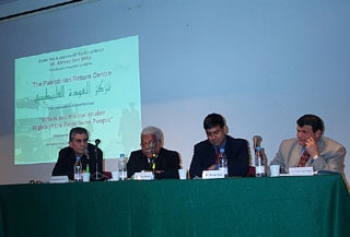
PRC Conference: Britain and the Inalienable Rights of the Palestinian People
In consistency with its general policy of documenting and claiming the rights of the Palestinian people, PRC- London held under the auspices of the former Algerian President Ahmad Bin Bella, its second international conference titled:” Britain and the Inalienable Rights of the Palestinian People” at Brunei Gallery in School of Oriental and African studies of London University.
The conference was held at the time when Britain and USA mobilized hundreds of thousands of their soldiers and exploited all their military and financial capabilities, and the newest inventions of destructive technology to invade Iraq and occupy it on the plea of carrying out international legitimacy and liberating Iraqi people from the tyranny of Saddam Hussein’s regime.
The conference aimed at conveying a simple message, of an underlying idea that if Britain is concerned about the international legitimacy, UN resolutions and human rights, it ought to fulfill the obligation that has fallen into its responsibility years ago, and start rallying international corroboration to expel the Zionist occupation, and mobilize its forces to dismantle the Zionist apartheid in Palestine as it did with Saddam Hussein.
Since it existed, Israel has been an illegitimate rouge state that violates the international law and disdain UN’s resolutions, yet it is supported by USA, military and political wise and by Britain economic wise.
In the presence of many political and academic distinctive characters and a large number of British and Arab attendances, international law experts and other specialists discussed from political, historical, and legal perspectives the role of Britain in Palestine and its responsibilities of the massacres perpetrated by the Zionists during the British Mandate over Palestine.
The conference was started with a recitation of the holy Koran, and then it was followed by a moment of silence to salute the souls of martyrs in Palestine including the human shields who were killed by the Israeli forces.
The opening session started with Mr. Majed Al Zeer’s Address on behalf of PRC. Mr. Al Zeer said: Now that the dust of war in Iraq started to settle, everyone is wondering who’s next, and what’s next? The list of questions seems to be much longer than the answers; yet, from everything said or done one fact is revealed: Palestine is still the case. Mr. Al Zeer explained that PRC decided to organize this conference in an attempt to fill the gaps of information; and assured that the Palestinian cause has unique features as Palestine has been subjected to a process of colonization from which it is yet to be liberated and that its colonization was not by a sole power but rather by an alliance of major powers.
Then he pointed out that some people might object using the term “colonization” with regard to Palestine as it is an outdated term for usage in the 21st. century; yet, “we nevertheless believe that mentioning it is not only correct but also necessary” said Al Zeer. ” Vladimir Jabotinsky, father of “Zionist revisionism” admitted: it doesn’t matter what kind of words we use to explain our colonization, colonization has only one goal. Zionist colonization, even the most restricted must decide and carry out without taking into consideration the will of the native people. This is frankly our policy towards the Arabs, to formulate it in any other way would be mere hypocrisy” added Al Zeer.
He also explained that Jabotinksy was clear and extremely accurate in his declaration as he confirmed that the Palestinians were devoted to their lands as much as any other people who faced a similar fate. “For this precise reason we are gathered today to discuss the unceasing Palestinian quest to restore and exercise their national rights” said Al Zeer.
Mr. Al Zeer refused to consider the Arab- Israeli conflict as one that is based on historic hatred between Arabs and Jews, he rather considered it a political struggle for the realization of Palestinian national aspirations whose nationalism didn’t emerge from the establishment of Israel and expulsion of the majority of Palestinians. Their nationalism existed a long time before their contact with the Zionist movement. He also iterated that the Israelis wouldn’t escape prosecution with regard to the crimes they have committed against the Palestinians people; and that Palestinians are not the only conscientious people, as the protestors against wars and aggression in the world stand by their side in the quest of their inalienable rights.
Mr. Al Zeer stressed that the Arab- Zionist conflict is not only about a dispute over land, but also related to the right of Palestinian people to return to their county. He also appealed for a settlement for this conflict, not on the basis of the existing military imbalance, but rather in the light of international law and the right of Palestinian people to return to their homeland and their rights of independence and sovereignty in Palestine.
Then he wondered about the role of the UN toward the Palestinian issue, at the time when USA and Britain invaded Iraq on the pretext of preventing the violation of international resolutions. Mr. Al Zeer stated that the Palestinians are not asking for something impossible or hard to achieve, they are rather claiming for rights guaranteed by international law.
The first session was chaired by Mr. Sabah Al Mukhtar, lawyer and chairman of the Arab Lawyers Association in Britain, who said that nowadays it is rather odd to speak about rights and laws while the world is watching two super powers resorting to nothing but mere force.Al Mukhtar pointed out that what is taking place in Iraq and Palestine is a reminder of what took place before, when Baghdad was invaded at the beginning of the twentieth century.
The British commander who led the invasion declared that they had come to liberate Iraq from the Ottoman domination. Similarly, the current invaders claim that they have come to liberate Iraq from the tyranny of Saddam Hussein. Al Mukhtar asserted that as long as the Palestinians stay in their land and keep resisting those who extort their rights, the occupation would be terminated no matter how long it takes. He added: “we are not red Indians and what happened to them will not happen to us”. He also predicted that the liberation of Palestine and Iraq is not far.
Britain’s International Responsibility in Palestine Before the Mandate (Sykes – Picot, Balfour, San Remo)
The first paper presented was that of Dr. Youssef Al Choueiri, researcher in Arabic and Islamic history, and director of the Academy of Advanced Islamic and Arabic Studies in Exeter University. Dr. Choueire’s presentation was titled:” Britain’s International Responsibility in Palestine Before the Mandate (Sykes – Picot, Balfour, San Remo)”. He discussed the historical features of Britain’s responsibility with regard to the establishment of the Israeli state on the historical land of Palestine; and highlighted the Sykes- Picot Agreement that divided the Arab regions into weak entities and the Balfour Declaration that promised to establish a “national home for the Jews” in Palestine considering it the basic foundation of establishment of an Israeli state.
Dr. Choueiri pointed out that Britain broke all its promises to the Arabs who fought by its side against the Ottomans, while, on the other hand, it kept all its promises to the Jewish party and saw that they set up the right climate for the establishment of the Israeli state by facilitating Jewish emigration and arming Zionist gangs.
Dr. Choueiri noted that the Balfour Declaration referred to the Jews as the “People” and to the Palestinians, the landowners, as “non Jews”. He added that, at the beginning Britain wanted to gain a foothold for itself in Jaffa, but then it managed to take Mosul from the French, and worked on linking Iraqi oil pipelines to Middle Eastern harbours. Notwithstanding, it never showed any concern about the situation of the people who were subjected to partition. He added that Britain established the Israeli state for strategic purposes, because they needed a base in the region to control the Suez Canal and obstruct the Egyptian role.
The International Responsibility of Britain as a Mandatory Over Palestine
Dr. Shafik Al Masri, Professor of international law in the American University of Beirut, and Lebanese University, gave a presentation titled: “The International Responsibility of Britain as a Mandatory Over Palestine”, in which he considered that Palestinian rights are deeply rooted in the history, he added that as they are the indigenous people of Palestine, Palestinians are entitled to the unquestionable right of self-determination as any other peoples.
Professor Masri noted that questions likely to be raised are related to the legal status of the Palestinian people between 1920- 1948, the Mandatory’s responsibility for the plight of Palestinian people, and the Zionist crimes committed before and after the establishment of the Israeli state.
Regarding the attitude of Israel towards international resolutions, Dr. Al Masri remarked that the only international resolution that Israel ever abided by was the one that facilitated its establishment in Palestine, although it totally disregarded the part that acknowledges the existence of a Palestinian state.Following this presentation the conference floor was opened for comments. Professor Salman Abu Sitta, the prominent expert on Palestinian refugees’ issues, who participated by phone from Kuwait, pointed out that in no other historical case did a mandatory power allow ethnic cleansing and foreign settlement on a scale as did occur in Palestine under the supervision of the British government who was supposed to assist Palestinian institutions on its way to independence. He added that in the first year of the Mandate Britain created the Israeli state after a long chain of facilitating procedures. The most crucial of these procedures was the formation of the Haganah gangs that paved the way to the establishment of the Israeli state by brutal massacres and crimes. Britain also crushed any Arab resistance against foreign settlements and the confiscation of lands, and banned the Arab efforts to arm themselves for self-defence. He also pointed out that Britain’s responsibility for the crimes committed in Palestine throughout the mandate period is referred to the fact that Britain set up the climate to impose the Zionist existence by means of force. He asserted that the British Mandate who had full political, military, administrative, and security control over historical Palestine, did not defend the Palestinian civilians, instead, they were objects of Zionist criminal gangs. Dr. Al Masri concluded by saying that Britain refused to fulfill its obligations as a mandatory power. He added: if Ben Gurion was the one who led the Haganah attacks against the Palestinian people, history, nevertheless, records Britain’s role in creating this tragedy.
Replying to some participation, Dr. Choueiri said that the British were convinced that the Zionists had no right in Palestine as much as they were convinced that Britain had no right to France. He explained that while USA did not enter the war until very late, British officials were convinced that Jews, with the power they had in Russia, were capable of stopping supplies to Germany from southern Russia; and capable of convincing America to support Britain’s war effort. Palestine was evidently a military gate for the whole region (Suez Canal and Egypt) and the British visualized Palestine as a military base that would enable them to control the whole region.
As for the reason why Rothschild was the one to receive the Balfour Declaration, it was because he was the leader of British Jews, and his family provided the British government with a loan to buy shares in the Suez Canal after they were put up for sale by Khedive Ismail. Thus Britain became the possessor of the greatest portion of shares in Suez Canal.
In regard to Britain’s current responsibility, Dr. Choueiri stated that Britain ought to acknowledge its responsibility of what happened to the Palestinian people and it must issue a statement admitting that it failed to determine the interests of both, Arabs and Jews, because its task was basically establishing two states, while everyone knows that Israel kept expanding its territories, while the Palestinians ended up with no state.
He added that Britain ought to acknowledge its mistakes and try to find a solution that satisfies the Palestinians in the first place and then Jews. “Yet, we don’t live in the land of dreams”, said Dr. Choueiri, “Nobody does anything for charity, the Arabs must give something in return, and Arab countries ought to exert pressure to prove that they still exist as countries and that they are concerned about the interests of their people”.
“Zionist Massacres Before 1948, Whose Responsibility?”
The second part of the first session was chaired by Dr. Azzam Al Tamimi, who presented Professor Ahmad Abu Al Wafa, professor of international law and vice chairman of the School of Law in Cairo University, Abu Al Wafa’s paper was titled: “Zionist Massacres Before 1948, Whose Responsibility?” In it, he affirmed that from a legal point of view Britain is partially responsible for the Zionist massacres committed against Palestinian people in 1948, the year the Israeli state was created.
Abu Al Wafa asserted the responsibility of the Mandatory power with regard to the crimes committed in Palestine during the mandate. He said that Britain was ruling Palestine until 1948, and thus it is held responsible of all what took place during that period. He remarked that Britain failed to enforce law and order and prevent stop crimes. He added that the Mandate had military power and political and administrative authority and was thus responsible for the crimes that were committed under its power because they were capable of hindering it, but they didn’t.
Professor Abu Al Wafa observed that when the Palestinians were convinced that international law is not respected by super powers, they chose the alternative of resistance, because it was the only way to realize their national rights. He added that the Zionists imposed themselves by means of violence and war crimes, and this fact gives justification for the Palestinian resistance, as it is a resistance to restore extorted rights.”British – Zionist Military Cooperation During the Mandate and the Suppressing of Nationalistic Movements”.After that, Dr. Mohsen Saleh, head of the history department at the International Islamic University in Malaysia, and the expert in the history of Mandate period, gave a presentation titled: “British – Zionist Military Cooperation During the Mandate and the Suppressing of Nationalistic Movements”.
British – Zionist Military Cooperation
In his presentation Dr. Saleh demonstrated different kinds of British – Zionist military cooperation in the two decades before the establishment of the Israeli state. He remarked that British Mandate had direct authority over everything, thus the British forces took advantage of this situation to establish the core of the Zionist army, whose first features started to appear through the Haganah gangs. On the other hand, Britain was very strict in hindering the formation of any military force on the Palestinian side; allowing only the presence of a limited number of Palestinian police.Dr. Saleh noted that Palestinian uprisings against the growing existence of Zionists in Palestine were viciously suppressed by Britain. He also asserted that most of the Palestinian victims and martyrs in the uprisings in Jerusalem 1920, Jaffa in 1921, and throughout Palestine in 1936-39, were killed by British forces. According to Dr. Saleh, the process of preparing for the establishment of the Israeli state started with the formation of the Haganah gangs, and training of Jewish troops to take part in the Second World War. These very same troops later formed the core of the Israeli army.
Britain’s Role in Denying the Palestinian Right of Freedom and Self Determination and Independence
Dr. Nur Masalhah, Professor in Surrey University, chaired the second session. In his introductory remarks Dr. Masalhah said there is hardly a single positive word that can be used to describe the calamitous British mandate in Palestine, which once was an Arab state in 1917, and disappeared from the map in 1948, because Britain gave the land that it did not own, to people who did not live in it. He accused Britain of being responsible of disarming the Palestinian people before the establishment of the Israeli state, and asserted that Britain should apologize for all that took place in Palestine, just it apologized to the Indian people for the massacres they were subjected to during British colonization.
After that Mr. Mahdi Al Dajani, a Palestinian lawyer and political expert, presented a paper titled: ” Britain’s Role in Denying the Palestinian Right to Freedom and Self Determination”. He pointed out that the current British government refuses to apologize to the Palestinians, because what happened in Palestine was committed by former governments. Yet, he maintained, history holds governments, individuals, and leaders responsible of their acts and reminds them of it from time to time.
Al Dajani explained that the relation between the Palestinian people and the British government after the imposition of the mandate in 1922 was not based on legality because a mandate should be authorized by a party that has legal right to do so, whereas the League of Nations did not have such authority. He added a Mandate should be carried out on legally incompetent people, which was not the case of the Palestinian people, for although Palestine ceased to be under Ottoman dominion, yet there was a national Palestinian dialogue about its future and alternatives of remaining a part of Greater Syria or declaring independence were discussed.
He added that the British government was acting on the basis of oriental concepts and the concept of “the white man’s burden”, considering its dominion over Palestine an occupation rather than being a mandate. Al Dajani refused to use the term colonization, because he believed that it doesn’t give the right description of what actually took place, as a mandate was supposed to bring prosperity.
Mr. Al Dajani pointed out that Britain described itself as a mandatory power after finding itself an occupying power. In fact, the administration that was established in Palestine under the leadership of General Allenby, was called the “Administration of Occupied Enemy Land”. Thus Britain to wanted to appear as an arbitrator between Arabs and Jews. In this context he emphasized three distinct rights of the Palestinian people: living freely, establishing an institutional state, and self-determination. He then noted the right to resist which is not remarked in the legal literature, and considered it more important than all of the other rights, because without it no rights could be obtained.
Al Dajanai stated Britain had deprived the Palestinians of the right to resist; thus when an armed resistance movement led by Ezziddine Al Qassam emerged, Britain criminalized its members and described them as “crooks”. He also noted that Jack Straw’s latest statements with regard to Palestine demonstartes contemporary governments’ attempts to remain aloof from the acts of former governments. In international law, however, governments hold part of the responsibilities of former governments. For example the present German government is still paying for the acts of the Nazis, although there is a great difference in the nature of both governments.
Al Dajani urged the British government to reconsider its policy with regard to Palestine and issue a historical apology, not necessarily for the sake of the Palestinian people who already know their path and won’t gain any benefit from such apology, but rather for the benefit of the British government itself. Additionally, Mr. Al Dajani asserted that the gap between the governments of globalization and their peoples is widening, and that such an apology will ease some of the historical and ethical burdens of Britain and all the Europeans.
The Mandatory Origins of Israel’s Deportation and Administrative Detention Laws
Then Mr. Usama Halabi – a Palestinian Lawyer- presented a paper titled” The Mandatory Origins of Israel’s Deportation and Administrative Detention Laws” in which he explained how did the laws of the British Mandatory become a part of Israeli law, and how it was carried out on Palestinians in Israel or in the 1967 occupied territories. Mr. Halabi explained that Israel succeeded the British Mandatory in dominating the land. He added that most of the basic Palestinian laws were referred to as orders and not laws, and pointed out that the defence regulations issued by the British during their mandate over Palestine, were later considered part of Israeli law. Mr. Halabi also explained that mere doubts were more than enough to deport or arrest someone or destroy his house or close it, and that destroying or sealing a house might have been carried out on a whole family that had no idea about the accusations even though suffered from it. This was a collective form of punishment involving innocent people.
He recalled that Menahem Begin was obliged to go underground in 1946 because of British defence regulations, which he described as Nazi in character. Later he used the same laws against the Palestinians in 1980 when he was prime minister. Similarly, Jacob Shafira who was deported to Africa, (later became a minister of Justice) was against defence regulations and described it in 1946 as “unparalleled in any civilized country” and that they “destroy the very foundations of justice in this land”, yet these regulations are still valid until now. He added that the British used regulation 111 in 1945 as a legal base for administrative detention or house demolition, and that is exactly what Israel is doing as an occupying force until now in many forms, like prohibiting Arabs of issuing any publication and confiscating their property.
He also stated that the Israeli government enforced Defence Regulations (reg. 125) to keep landowners from reaching their lands, and then declaring it “closed military areas” and then confiscating it for being neglected. As a result 93 percent of the Palestinian territories are now Israeli possessions, while what is left for the Palestinians in Israel is only 3 percent. In other words, they became refugees in their own land. He added that the Israelis didn’t only adopt the regulations of the British Mandate but they also adopted their legal techniques; thus the emergency regulations enforced nowadays by the Israelis is of British origin.
Black Intifada: the Mau Mau Uprising and the Palestinian Experience in Comparative Perspective
In the final session chaired by Dr. Bahsir Nafi’e the conference heard a paper from Professor Ali Mazrui, Director of the Institute of Global Cultural Studies, whose presentation was titled: “Black Intifada: the Mau Mau Uprising and the Palestinian Experience in Comparative Perspective”.
Dr. Mazrui spoke about the old British offer to establish a Jewish state in Africa (parts of Uganda and Kenya) before Palestine. He compared between Palestine and Kenya (his home country) and stated that they share four features, as both of them were colonized and both were nominated to be an occupied country for Jews. Additionally, the two countries witnessed armed resistance, as Kenya witnessed a black uprising led by the black Mau Mau tribes between 1951-1952 in an attempt to put an end to the British occupation similar to the Palestinian uprising aimed at terminating Zionist settler occupation; and the fourth feature is the transmission of the Palestinian conflict to east Africa that became a theatre of battle.
Mazrui noted that the concept of a “land without people for people without land” was carried out in eastern Africa because Britain didn’t consider Africans real people, and because Palestine at that time was under Ottoman dominion, thus giving the Jews a state in eastern Africa was easier at that time. When the Jews refused the British offer, Britain converted Kenya into a “white colony”.
Comparing between Mau Mau and Palestinian uprisings Mazrui stated that in both cases arm balance in the conflict was not equivalent, and as Israeli forces used missiles and tanks, the British forces carried out air raids against Mau Mau people. On the other hand, although Mau Mau people didn’t adopt a martyrdom concept, yet they still deserve the credit for Kenya’s independence as they sacrificed themselves so that another generation could live freely.
Dr. Mazrui concluded by saying if the Mau Mau revolution had succeeded, there might have been more sympathy with the causes of the oppressed peoples around the world, and considered that it is not too late for the Kenyan government to become an ally of the Palestinians.British Current Policy Towards the Arab- Israeli Conflict in the Light of International Law: the Case of Palestinian Refugees
Dr. Al Mazrui was followed by Professor Siraj Al Sait, lawyer and professor of international law in East London University, and expert in international law, who presented a paper titled:”British Policy Towards the Arab – Israeli Conflict in the Light of International Law: the Case of Palestinian Refugees”. Professor Sait talked about prejudice in the international law, and considered the case of Palestinian refugees the best example of the way international law deals with the Palestinian cause, since their situation is based on not acknowledging their problem in the international law. He pointed out that sources of international law are of no use if states don’t abide by them, and that the “basic foundations of law acknowledged by civilized countries”, can be regarded as a form of bigotry as they divide the world into civilized and uncivilized.
He added that one of every four refugees in the world is Palestinian, yet the Palestinians are the only group exempted from the 1951 Refugee Convention that mentions the holocaust, and yet totally refuses to look into the case of the Palestinian refugees, since they are supposed to be protected by the UN Conciliation Commission for Palestine which has collapsed in effect, leaving UNRWA as the only functioning organ to provide assistance to the Palestinian people. Moreover, the issue of the refugees is now considered an obstacle on the way to settle the Palestinian cause, hence all the Israeli- Palestinian accords don’t mention the issue of the Palestinian refugees.
Sait also noted that concerted attempts were made to link the Palestinian refugees to terrorism particularly after the attacks of September the 11th on USA. Thus since the attacks, Israel found in the war against terrorism a convenient cover to terminate the uprising; in fact, very high percentage of uprising martyrs are refugees. He mentioned that after the Jenin camp massacre the Security Council did not even acknowledge the siege. They rather appealed to both sides to stop the violence, and equated between the aggressor and the victim while the world was watching the acts of killing the refugees including disarmed women and children. Neither the Security Council nor the Secretary General admitted once that the victims were refugees, as there is not a single word about the rights of the refugees.
Mr. Sait added that the history would consider the exception of Palestinian refugees a conspiracy to deprive them of protection and from their country and their rights. He also pointed out that denying the refugee status of the Palestinians makes it easier to target them and disregard their claim for their land and other human rights.
Israel is a Rogue State according to the UN
Dr. Ahmed Abdelwanis, professor of international law in Faculty of Economics and Political Science at Cairo University then presented a paper titled: “Israel is a Rogue State According to the UN”. He started his presentation by saying that the Palestinian cause is the issue, and without the Israeli violation of Palestinian rights there wouldn’t have been such a conference. Accordingly, he added, it was appropriate that the conference should end with a paper about Israel as a rogue state that does not abide by international law and the Charter of the UN. He described Israel as an outlaw state according to American concepts and added that there are some special features in Israel’s disobedience. He explained that the defiance of international law means not respecting it and not abiding by the rules and regulations of international law and the principles that members of the international community must not violate.
Then he stated three forms of Israeli disobedience:-Neglecting international obligations, not abiding by it, not attending the meetings that discuss these obligations, and regarding the international treaties as not applicable to it. One example is the Fourth Geneva Convention which accord to Israel is not applicable on the Palestinians since they are terrorists who don’t have the right to resist occupation. Another example of such disobedience has been Israel’s refused to allow an international fact finding mission to investigate the crimes perpetrated in Jenin camp in 2002.
-Disregarding and insisting on disrespecting international commitments-Disregarding the dictates and imperatives of international legitimacy.Professor Abdelwanis explained the motivations of the Israeli defiance of the international law:-The nature of the Zionist state that was illegitimately established in the light of international law.-The weak regional Arab regimes that lack accord and solidarity, and have many political disputes among themselves.-Israel’s relations with the superpowers, specifically Britain and USA. USA considers the preservation of Israel and maintenance of its security a national commitment.He concluded that Israel’s intransigent techniques are also significant, for such disobedience demands deep understanding of the sociology of international law. He affirmed that effective opposition to Israel’s disobedience lies in Arab unity and the development of their political, military, and financial capabilities.
How could USA put an end to the Israeli occupation when it is doing the same in Iraq?
Professor Nasir Aruri participated from USA by telephone. In his presentation he said that Israel’s violation of international law is an old story and its crimes are countless. He compared the Anglo-American occupation of Iraq to the Israeli occupation in Palestine. In both cases the acts of the occupier are described as war against terror, whereas terror is used against the people of both countries, and in both cases they speak about preventive war while destroying the civil rights, state institutions, culture and history of the occupied peoples. He wondered how could USA put an end to the Israeli occupation when she is doing the same in Iraq. Aruri added that there is a great similarity between the Washington administration and the Israeli government, as both of them are extremist and both have made their countries rogue states condemned all over the world.
The conference ended with some closing remarks by Mr. Zahir Al Birawi (chairman of board of trustees of the PRC). He thanked the lecturers, participants and the PRC team. Birawi said that Britain is ethically and legally responsible for the plight of the Palestinian people and that the British government should try to correct what has been done during the mandate and the ensuing period.Birawi mentioned that the British government turned down an invitation to attend the conference. Notwithstanding he hoped that the conference would have an impact in Whitehall noting that the Zionist conference that was held in 1905 and 1907 in London played a deep role in issuing Balfour Declaration, and hoped that PRC’s conference would play a similar role in correcting that mistake and enabling the Palestinians to exercise their right to return.
-End-